
Home Electrical Safety Inspection A Complete Guide for Homeowners in Dubai
Scheduling a professional home electrical safety inspection is essential because your home’s electrical system is one of those things you probably don’t think about until something goes wrong.
The lights work, the air conditioner turns on, the sockets provide power, and your appliances run normally. So, everything must be fine — right?
Not necessarily.
Electrical problems can develop behind walls, inside distribution boards, around sockets, or within aging wiring without producing obvious signs at first. In some cases, a small electrical issue can eventually lead to equipment damage, power interruptions, fire hazards, or serious safety risks.
That is why a Home Electrical Safety Inspection can be an important part of responsible property maintenance.
Whether you own a villa, apartment, or another residential property in Dubai, an electrical inspection can help identify potential problems before they become expensive or dangerous.
In this guide, we’ll explain what a home electrical inspection involves, what an electrician checks, common warning signs, estimated inspection costs in Dubai, and when professional electrical inspection is more appropriate than a basic DIY check.
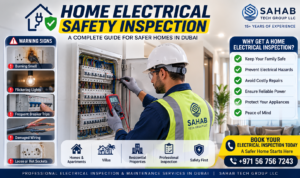
What Is a Home Electrical Safety Inspection?
A Home Electrical Safety Inspection is a systematic assessment of a property’s electrical system to identify visible defects, potential safety hazards, overloaded circuits, faulty components, wiring problems, and other conditions that may require attention.
Unlike simply checking whether lights and sockets are working, a professional inspection looks at the electrical system more broadly.
Depending on the property and inspection scope, an electrician may assess:
- Electrical wiring
- Distribution board
- Circuit breakers
- RCD/RCBO protection
- Sockets
- Switches
- Earthing
- Electrical connections
- Lighting circuits
- Appliance connections
- Visible cable condition
- Signs of overheating
- Circuit loading
- Outdoor electrical connections
- Other accessible electrical components
The purpose is not simply to find something wrong.
Instead, the objective is to understand whether the home’s electrical system is operating safely and whether there are signs that repairs, maintenance, or further investigation may be required.
Why Is a Home Electrical Inspection Important?
Electrical systems can deteriorate gradually.
A loose connection, damaged cable, overloaded circuit, or faulty protective device may not immediately cause a complete electrical failure.
However, ignoring such issues can allow them to become more serious.
A professional residential electrical inspection can help homeowners identify problems before they result in major disruption.
Some potential benefits include:
- Identifying electrical safety hazards
- Detecting visible wiring deterioration
- Finding overloaded circuits
- Checking protective devices
- Identifying overheating signs
- Assessing accessible electrical connections
- Reducing the possibility of unexpected electrical failures
- Helping homeowners plan necessary repairs
- Providing greater confidence when purchasing or maintaining a property
For older properties, inspections can be particularly useful because electrical systems may have been modified several times over the years.
New appliances, additional air-conditioning units, renovations, extensions, and electrical modifications can all change the demands placed on the original system.
When Should You Get a Home Electrical Safety Inspection?
There is no single situation in which every homeowner must arrange an inspection.
However, several circumstances make an electrical inspection particularly worthwhile.
1. You Are Buying a Property
A property can look perfect during a viewing while electrical problems remain hidden.
Before purchasing a villa or apartment, an electrical inspection can help identify potential concerns that may not be obvious during a normal viewing.
This can be especially useful when purchasing an older property.
2. You Are Selling Your Home
An inspection can also be useful before selling.
Identifying electrical problems early gives homeowners an opportunity to address them rather than discovering them during a buyer’s inspection.
3. Your Property Is Older
Older homes may contain aging wiring, outdated components, previous modifications, or electrical installations that have experienced years of use.
That does not automatically mean the system is unsafe.
However, age can be a good reason to have the electrical system professionally assessed.
4. You Have Recently Renovated
Renovations often involve changes to electrical systems.
New:
- Lighting
- Air conditioners
- Kitchen appliances
- Water heaters
- Sockets
- Rooms
- Equipment
can increase electrical demand.
After significant renovation work, checking the electrical system can help confirm that the installation is appropriate for the property’s current requirements.
5. You Experience Frequent Breaker Trips
A circuit breaker that trips occasionally may be responding to a genuine electrical problem.
Possible causes can include:
- Circuit overload
- Faulty appliance
- Short circuit
- Wiring problem
- Faulty breaker
- Electrical equipment malfunction
Repeatedly resetting the breaker without investigating the cause is not a good long-term solution.
6. You Notice Burning Smells or Heat
A burning smell around an outlet, switch, appliance connection, or electrical panel should never be ignored.
Likewise, unusually hot sockets, switches, or electrical components can indicate an issue that requires professional attention.
Signs Your Home May Need an Electrical Inspection
Some electrical problems provide warning signs before becoming more serious.
Therefore, homeowners should pay attention to changes in how their electrical system behaves.
Flickering or Dimming Lights
If lights repeatedly flicker or become noticeably dim when certain appliances operate, the issue should be investigated.
It could be related to:
- Loose connections
- Circuit loading
- Wiring problems
- Electrical equipment
- Other system faults
Not every flickering light indicates a major electrical problem, but persistent or widespread flickering deserves attention.
Frequent Circuit Breaker Trips
A breaker is designed to interrupt electrical supply when a circuit experiences certain abnormal conditions.
If the same breaker keeps tripping, there may be an underlying issue.
Instead of repeatedly switching it back on, homeowners should identify why it is happening.
Burning Smell
A persistent burning or melted-plastic smell near electrical equipment is a serious warning sign.
Possible sources can include overheating wiring, connections, sockets, switches, or appliances.
If you notice this type of problem, avoid attempting electrical repairs yourself and seek professional assistance.
Buzzing or Crackling Sounds
Electrical components should generally operate without persistent buzzing, sizzling, or crackling noises.
Such sounds can indicate loose connections, damaged components, arcing, or other faults.
Discoloured Sockets or Switches
Brown, black, melted, or visibly discoloured electrical outlets and switches should be inspected.
Discolouration can be a sign of overheating.
Sparks From Sockets
A small visible spark can occasionally occur under certain circumstances, but repeated or unusual sparking should not be considered normal.
If a socket consistently sparks when an appliance is connected or disconnected, professional assessment is recommended.
Electrical Shocks
Even a minor electrical shock from an appliance, switch, or other electrical equipment should not simply be ignored.
It can indicate a grounding, insulation, appliance, or wiring problem.
Old or Damaged Wiring
Visible cables that are cracked, exposed, deteriorated, improperly secured, or otherwise damaged should be assessed by a qualified professional.
Never attempt to repair damaged electrical wiring without the appropriate expertise.
What Does an Electrician Check During a Home Electrical Inspection?
A professional inspection can cover multiple components of the home’s electrical system.
The exact scope depends on the property, accessibility, age, and reason for the inspection.
1. Electrical Distribution Board
The distribution board is one of the most important areas of the home’s electrical system.
An electrician may inspect:
- Circuit breakers
- Connections
- Labelling
- Signs of overheating
- Physical condition
- Protective devices
- Circuit arrangement
A properly maintained distribution board helps organize and protect the property’s electrical circuits.
2. Circuit Breakers
Circuit breakers are designed to interrupt electrical supply when certain abnormal conditions occur.
During an inspection, an electrician may assess their condition and operation.
Repeated breaker trips can also provide useful clues about potential circuit or appliance problems.
3. RCD and RCBO Protection
Residual-current protection devices can provide an additional layer of electrical safety by responding to certain leakage conditions.
An inspection may include checking the appropriate protective devices and, where applicable, testing their operation using suitable procedures.
4. Electrical Wiring
Accessible wiring may be checked for signs of:
- Damage
- Deterioration
- Loose connections
- Poor routing
- Overheating
- Exposed conductors
- Other visible defects
Not all wiring inside walls can be visually inspected without invasive work. Therefore, homeowners should understand that a standard inspection does not necessarily mean every cable inside a building has been physically examined.
5. Sockets and Switches
Electrical outlets and switches are commonly inspected for:
- Physical damage
- Loose fittings
- Discolouration
- Heat damage
- Poor connections
- Signs of excessive loading
Sockets that feel unusually hot or show visible damage should receive particular attention.
6. Earthing and Grounding
Proper earthing is an important component of electrical safety.
An electrician may assess accessible grounding arrangements and perform appropriate electrical tests where required.
A grounding issue can potentially affect the safety of people and connected equipment, making this an important part of a professional electrical inspection.
7. Lighting Circuits
Lighting circuits and accessible connections may also be checked for visible damage, loose components, inappropriate modifications, or other issues.
This becomes particularly important when a property has undergone multiple lighting upgrades over time.
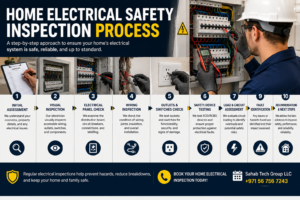
Home Electrical Inspection Process
A professional electrical inspection generally follows a structured process rather than simply walking through the property and checking a few sockets.
While the exact procedure varies, the process can generally include the following stages.
Step 1: Initial Property Assessment
The electrician first understands the property and the reason for the inspection.
They may consider:
- Property type
- Approximate age
- Recent renovations
- Electrical complaints
- Major appliances
- Previous electrical work
- Known problems
Step 2: Visual Inspection
The accessible electrical components are examined for visible warning signs.
This may include:
- Distribution boards
- Switches
- Sockets
- Wiring
- Electrical equipment
- Visible connections
Step 3: Electrical Testing
Appropriate electrical testing may be carried out using professional test equipment.
The exact tests depend on the installation and inspection requirements.
Step 4: Problem Identification
If an issue is identified, the electrician determines its likely source and severity.
For example, repeated breaker trips could require investigation of the circuit, connected appliances, wiring, or protective device.
Step 5: Recommendations
The homeowner can then receive recommendations regarding:
- Maintenance
- Repairs
- Component replacement
- Further testing
- Electrical upgrades
The important thing is to distinguish between an issue that requires immediate attention and a recommendation that can reasonably be planned for later.
Home Electrical Inspection vs Electrical Maintenance vs Electrical Repair
These terms are sometimes used interchangeably, but they are not the same.
| Service | Main Purpose | When It Is Used |
|---|---|---|
| Electrical Inspection | Identify potential issues and assess system condition | Before buying, after problems, periodically, or after renovation |
| Electrical Maintenance | Keep the system operating properly | As part of ongoing property maintenance |
| Electrical Repair | Correct a specific fault | When an electrical problem has been identified |
For example, if your home’s circuit breaker keeps tripping, an inspection can help identify the underlying problem.
Once the problem is identified, repair may be required.
Afterward, appropriate maintenance can help keep the electrical system in good working condition.
What Homeowners Can Check vs What Requires a Professional
Homeowners can perform some basic observations without opening electrical equipment or attempting repairs.
| Homeowner Can Observe | Professional Should Inspect/Test |
| Flickering lights | Circuit performance |
| Burning smells | Wiring faults |
| Damaged sockets | Electrical connections |
| Frequent breaker trips | Circuit loading |
| Visible cable damage | Electrical safety testing |
| Buzzing sounds | Electrical fault diagnosis |
| Hot switches/sockets | Connection and circuit assessment |
| Sparks | Fault investigation |
| Missing covers | Electrical component condition |
| Appliance-related issues | Electrical supply and circuit testing |
The key distinction is observation versus intervention.
A homeowner can notice that an outlet is hot.
They should not remove the outlet and attempt to diagnose or repair the wiring unless they have the appropriate qualifications and authorization.
Home Electrical Safety Inspection in Dubai
Dubai homes can have substantial electrical demands.
Modern villas and apartments may contain multiple air-conditioning systems, water heaters, kitchen appliances, entertainment equipment, washing machines, refrigeration systems, pumps, lighting systems, and other electrical loads.
Consequently, the electrical system must be capable of safely supporting the property’s actual requirements.
This is particularly relevant when a property has been upgraded over time.
For example, an older electrical installation may have been designed around the original requirements of a home. Years later, the property may have significantly more appliances and equipment.
That is why electrical inspection in Dubai can be useful after major renovations, property purchases, or when unusual electrical behaviour develops.
Homeowners should also ensure that electrical work and inspections are handled by appropriately qualified professionals and in accordance with applicable requirements.
Common Electrical Problems Found in Homes
Although every property is different, several types of issues are commonly associated with residential electrical systems.
These can include:
- Overloaded circuits
- Loose electrical connections
- Damaged outlets
- Faulty switches
- Aging wiring
- Poorly installed modifications
- Inadequate protection
- Electrical panel issues
- Damaged cables
- Faulty appliances
- Grounding/earthing concerns
- Improper extension-cord use
Importantly, finding one of these issues does not automatically mean the entire electrical system needs replacement.
A professional assessment should determine the appropriate solution.
Why You Shouldn’t Ignore Small Electrical Problems
A common mistake is thinking:
“It’s only a small issue, so I’ll deal with it later.”
Perhaps the light flickers occasionally.
Maybe one socket becomes warm.
Perhaps the breaker trips once every few weeks.
These symptoms may have simple explanations, but they can also indicate developing electrical faults.
The safest approach is to investigate persistent or unusual electrical behaviour rather than repeatedly ignoring it.
Early identification can also make repairs easier to plan.
What Comes Next?
A proper Home Electrical Safety Inspection is not about creating unnecessary concern.
It is about understanding the condition of an electrical system and identifying potential problems before they become more disruptive.
Cost, Common Problems, and What Happens After an Inspection
Home Electrical Inspection Cost in Dubai
One of the first questions homeowners usually ask is:
“How much does a home electrical inspection cost in Dubai?”
The answer depends on several factors because no two properties have exactly the same electrical system or inspection requirements.
A basic inspection of a small apartment will generally require less time and testing than a detailed electrical assessment of a large villa with multiple distribution boards, extensive wiring, outdoor electrical systems, and numerous appliances.
As a general planning guide, homeowners may encounter the following estimated ranges:
| Type of Electrical Inspection | Estimated Cost in Dubai |
|---|---|
| Basic electrical safety check | AED 250 – 500 |
| Standard home electrical inspection | AED 400 – 800 |
| Detailed villa electrical inspection | AED 600 – 1,500+ |
| Larger residential property inspection | AED 1,000 – 2,500+ |
| Electrical fault diagnosis | AED 250 – 800+ |
| Additional electrical testing | AED 100 – 500+ |
These are indicative estimates rather than fixed market prices.
The final cost can change depending on the property size, number of electrical circuits, number of distribution boards, accessibility, testing requirements, property condition, and whether faults need to be investigated.
Therefore, getting a quotation based on the actual property is more reliable than relying on a generic inspection price.
What Affects the Cost of a Home Electrical Inspection?
Several factors can influence the final price of a residential electrical inspection.
Property Size
A small apartment may have a relatively compact electrical system.
A large villa, on the other hand, may contain:
- Multiple floors
- Several distribution boards
- Outdoor electrical circuits
- Pumps
- Water heaters
- Multiple AC systems
- Extensive lighting
- Kitchens with high-power appliances
- Additional electrical equipment
Naturally, inspecting a larger and more complex system can require more time.
Number of Electrical Circuits
The number of circuits also matters.
A property with a small number of circuits may be relatively straightforward to inspect.
However, larger properties can have separate circuits for:
- Air conditioning
- Kitchen appliances
- Water heaters
- Lighting
- General sockets
- Outdoor equipment
- Pumps
- Other specialized equipment
More circuits can mean more inspection and testing requirements.
Number of Distribution Boards
Some villas and larger properties have more than one distribution board.
Each accessible board may need to be assessed for condition, circuit organization, protection, labelling, and other relevant factors.
Therefore, a property with multiple boards may require a more detailed inspection than a standard apartment.
Property Age
Older properties may require additional attention because of:
- Aging components
- Previous electrical modifications
- Older wiring
- Repeated repairs
- Outdated installations
- Changes in electrical demand
However, age alone does not determine whether an electrical system is safe.
The actual condition of the installation is what matters.
Previous Renovations
Renovations can significantly change an electrical system.
For example, a homeowner may add:
- New lighting
- Additional sockets
- Kitchen appliances
- Air-conditioning equipment
- Water heaters
- Home entertainment systems
- Outdoor lighting
If several modifications have been made over the years, a professional inspection can help determine whether the electrical system remains appropriately configured for the property’s current requirements.
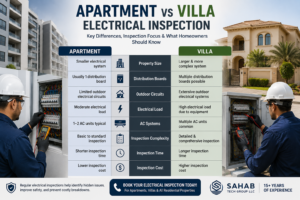
Apartment vs Villa Electrical Inspection
The inspection requirements can differ considerably between apartments and villas.
| Factor | Apartment | Villa |
| Property size | Usually smaller | Usually larger |
| Distribution boards | Often fewer | May have multiple |
| Outdoor circuits | Limited | More common |
| Electrical load | Moderate to high | Can be high |
| AC systems | Varies | Often multiple |
| Water heaters | Common | Multiple possible |
| Lighting systems | Moderate | Often extensive |
| Inspection complexity | Usually lower | Can be significantly higher |
This does not mean that apartment electrical systems are automatically simpler or safer.
An apartment can still have overloaded circuits, damaged sockets, faulty breakers, wiring problems, or other electrical issues.
The inspection scope should therefore be based on the property’s actual condition rather than simply its type.
Common Electrical Problems Found During Home Inspections
A Home Electrical Safety Inspection can reveal a wide range of issues.
Some are relatively simple to correct, while others may require further investigation or electrical repair.
1. Overloaded Circuits
One circuit may end up supporting more electrical equipment than it was designed to handle.
This can happen when homeowners add multiple high-power appliances or use extension leads and adapters extensively.
Warning signs may include:
- Frequent breaker trips
- Warm sockets
- Flickering lights
- Overheating
- Unexpected electrical interruptions
The appropriate solution depends on the actual circuit design and load.
2. Loose Electrical Connections
Loose connections can develop over time or result from poor installation.
They may contribute to:
- Heat generation
- Intermittent operation
- Flickering
- Sparking
- Equipment problems
Because connections are part of the electrical system, they should be assessed and corrected by a qualified professional.
3. Damaged Sockets and Switches
Cracked, loose, burned, discoloured, or damaged sockets should not be ignored.
Even when an outlet continues to work, physical damage can indicate an underlying problem.
4. Faulty Circuit Breakers
Circuit breakers are important protective components.
If a breaker repeatedly trips, fails to operate correctly, or shows signs of physical damage, further investigation may be necessary.
Replacing a breaker without determining why it is failing may not solve the underlying issue.
5. Poorly Installed Modifications
Residential electrical systems are sometimes modified as properties evolve.
A homeowner may add a new socket here, an additional light there, or a new appliance circuit during a renovation.
If modifications are not properly planned and installed, they can create problems within the wider system.
6. Aging Wiring
Electrical wiring can deteriorate over time depending on installation quality, environmental conditions, usage, and other factors.
Visible deterioration should be assessed rather than covered up.
In some situations, additional testing may be necessary to determine the condition of wiring that is not directly accessible.
7. Inadequate Labelling
A well-organized distribution board should make it reasonably clear which circuits correspond to which parts of the property.
Poor labelling can make troubleshooting and emergency isolation more difficult.
During an inspection, unclear or missing labels may be identified as an issue requiring improvement.
Common Home Electrical Safety Mistakes
Electrical problems are not always caused by the original installation.
Sometimes everyday habits contribute to unnecessary electrical risk.
Using Too Many Appliances on One Outlet
A single socket or extension lead should not be treated as an unlimited power source.
Connecting several high-power appliances through one outlet can place excessive demand on the circuit.
Overusing Extension Cords
Extension leads can be useful temporarily, but relying on them as a permanent substitute for appropriately installed outlets can create problems.
If you repeatedly need extension cables in the same area, it may be worth considering whether the electrical layout needs improvement.
Ignoring Warm Sockets
A socket that becomes noticeably hot should not simply be treated as normal.
Heat can indicate excessive loading, poor connections, equipment problems, or other faults.
Repeatedly Resetting a Tripped Breaker
If a breaker repeatedly trips, continually resetting it without identifying the cause is not a proper solution.
The reason for the trip should be investigated.
Using Damaged Electrical Equipment
Frayed cables, cracked plugs, broken sockets, and damaged appliances should not continue to be used simply because they still work.
DIY Electrical Repairs
Electrical systems are not an appropriate area for guesswork.
Opening distribution boards, modifying wiring, replacing electrical components, or making unqualified connections can create serious safety risks.
DIY Electrical Check vs Professional Inspection
There is a difference between looking for warning signs and conducting an actual electrical inspection.
A homeowner can safely observe many things without interacting with electrical components.
For example, you can notice:
- Flickering lights
- Burning smells
- Damaged sockets
- Buzzing sounds
- Repeated breaker trips
- Visible cable damage
- Unusual heat
However, professional inspection may involve electrical testing, circuit assessment, protective-device testing, and other procedures that require suitable training and equipment.
A simple rule is:
Observe problems yourself. Diagnose and repair electrical faults professionally.
This approach allows homeowners to remain aware of their property’s condition without unnecessarily exposing themselves to electrical hazards.
What Happens After a Home Electrical Inspection?
An inspection should not simply end with:
“Everything looks fine.”
A useful assessment should help the homeowner understand what was checked and whether any action is recommended.
Depending on the inspection scope, the findings may fall into several categories.
No Significant Issues Identified
The electrical system may appear to be operating satisfactorily based on the inspection and tests performed.
Even then, normal maintenance and monitoring remain important.
Minor Issues
Some problems may not represent an immediate serious hazard but should still be corrected.
Examples could include:
- Damaged socket covers
- Missing labels
- Loose fittings
- Minor installation concerns
- Maintenance-related issues
Significant Electrical Problems
Other findings may require prompt attention.
Examples can include:
- Serious overheating
- Repeated circuit faults
- Significant wiring damage
- Defective protective equipment
- Unsafe electrical connections
The electrician should explain the recommended corrective action.
Repair or Replacement: Which Is Better?
Finding an electrical problem does not automatically mean the entire electrical system needs to be replaced.
In many cases, a targeted repair may be sufficient.
| Situation | Possible Approach |
| Damaged socket | Replace socket |
| Faulty switch | Replace switch |
| Loose connection | Correct connection |
| Faulty breaker | Replace breaker after diagnosis |
| Minor wiring issue | Repair affected section |
| Repeated circuit overload | Assess circuit/load and modify as appropriate |
| Severely deteriorated wiring | Further assessment and possible replacement |
| Major outdated installation | Consider broader electrical upgrade |
The correct decision depends on the cause, severity, age, condition, and design of the electrical installation.
For example, replacing a single damaged socket makes sense when the rest of the circuit is in good condition.
However, repeatedly repairing individual components in a severely deteriorated electrical system may not be the most appropriate long-term strategy.
How Often Should a Home Electrical Inspection Be Done?
There is no universal schedule that applies equally to every property.
Inspection frequency depends on:
- Property age
- Electrical system condition
- Previous modifications
- Renovation history
- Electrical problems
- Property usage
- Major equipment
- Previous inspection findings
An inspection may be particularly worthwhile when:
- Buying a property
- Selling a property
- Moving into an older home
- Completing major renovations
- Adding substantial electrical loads
- Experiencing repeated electrical problems
- Not knowing the history of previous electrical work
Instead of focusing only on a fixed calendar interval, homeowners should consider the condition and history of their property.
Home Electrical Inspection After Renovation
Renovation is one of the situations where electrical inspection can be particularly valuable.
Modern renovations often involve much more than cosmetic improvements.
A kitchen upgrade, for example, can introduce additional:
- Ovens
- Dishwashers
- Refrigerators
- Extractor systems
- Microwaves
- Lighting
- Sockets
Similarly, a villa renovation may add new AC systems, lighting circuits, water heaters, pumps, outdoor equipment, and other electrical loads.
Therefore, the electrical system should be considered as part of the overall renovation rather than as an afterthought.
This is especially important when several contractors or modifications are involved.
Electrical Inspection and Home Renovation Planning
Electrical requirements should ideally be considered before renovation work begins.
For example, if you are planning a bathroom renovation, kitchen renovation, or villa interior upgrade, electrical requirements may need to be coordinated with:
- Lighting
- Appliances
- Water heaters
- Exhaust systems
- Sockets
- HVAC equipment
- Smart equipment
- Other electrical installations
This can help reduce the likelihood of discovering electrical limitations after the renovation has already been completed.
For homeowners planning broader property improvements, our related guide on Bathroom Renovation Cost and Complete Upgrade Ideas can also provide useful context when planning renovation work.
How Electrical Problems Can Affect Appliances
Electrical problems do not only affect the wiring itself.
Unstable or faulty electrical conditions can potentially affect connected equipment as well.
Modern homes contain many sensitive electronic devices, including:
- Televisions
- Computers
- Routers
- Refrigerators
- Washing machines
- Air-conditioning controls
- Home entertainment equipment
- Kitchen appliances
If you notice unusual appliance behaviour together with electrical problems, it is worth having the electrical supply and relevant circuits assessed.
However, appliance faults can also originate within the appliance itself, so proper diagnosis is important.
When You Should Arrange an Electrical Inspection Immediately
Some situations deserve faster attention than routine maintenance.
Contact a qualified electrical professional if you experience:
- Burning electrical smells
- Smoke from electrical equipment
- Repeated sparking
- Severe overheating
- Exposed live electrical components
- Repeated unexplained breaker trips
- Electrical shocks
- Significant electrical damage
- Water coming into contact with electrical equipment
If there is an immediate danger such as smoke or fire, prioritize personal safety and follow appropriate emergency procedures rather than attempting to investigate the electrical system yourself.
Why Professional Electrical Inspection Matters
A professional electrical safety inspection is valuable because electrical faults are not always visible.
A socket can look perfectly normal while the underlying connection has a problem.
Likewise, a breaker may appear functional while the circuit it protects has an underlying fault.
Professional inspection combines visual assessment with appropriate testing and technical knowledge.
That provides homeowners with a clearer understanding of the condition of their electrical system.
Electrical Inspection for Property Buyers
If you are purchasing a home in Dubai, an electrical inspection can be a useful part of your broader property assessment.
A normal property viewing focuses heavily on:
- Location
- Layout
- Finishes
- Rooms
- Kitchen
- Bathrooms
- General condition
However, electrical infrastructure can be much harder to assess visually.
Before committing to a property, buyers may therefore want to consider whether the electrical system has been professionally assessed, particularly if the property is older or has undergone extensive modifications.
An inspection cannot guarantee that every concealed defect will be discovered, but it can help identify accessible problems and provide useful information for decision-making.
How Sahab Tech Group LLC Can Help With Home Electrical Services
Once an electrical issue has been identified, the next challenge is finding a service provider capable of assessing the problem and recommending the appropriate solution.
Sahab Tech Group LLC provides property maintenance and technical services for residential, commercial, and industrial properties in Dubai.
Its broader maintenance capabilities can support property owners with electrical-related requirements alongside other building services.
Depending on the property’s needs, services may include:
- Electrical inspection
- Electrical maintenance
- Electrical troubleshooting
- Electrical repair
- Residential electrical services
- Building maintenance
- HVAC services
- Plumbing services
- Civil work
- Waterproofing
- Renovation-related services
This broader approach can be useful for homeowners who are dealing with multiple property maintenance requirements rather than a single isolated issue.
A Home Electrical Safety Inspection is not simply a checklist of sockets and switches.
It is an opportunity to understand how the property’s electrical system is performing, identify potential risks, and determine whether maintenance or repair is necessary.
For Dubai homeowners, this can become particularly important when purchasing an older property, completing renovations, adding major electrical equipment, or noticing unusual electrical behaviour.
The most important principle is simple:
Don’t wait for a serious electrical failure before paying attention to your home’s electrical system.
Regular awareness, professional assessment when necessary, and timely repairs can help homeowners maintain a safer and more reliable property.
Home Electrical Safety Inspection Checklist
If you are a homeowner, buyer, or property manager, having a basic checklist can help you recognize when your home’s electrical system may need professional attention.
Remember, this checklist is designed for observation, not DIY electrical repair.
Electrical Safety Checklist
| What to Check | What to Look For |
|---|---|
| Sockets | Cracks, looseness, discoloration, unusual heat |
| Switches | Damage, buzzing, unusual operation |
| Lights | Flickering, repeated dimming, unexplained outages |
| Circuit breakers | Frequent or unexplained trips |
| Distribution board | Visible damage, overheating, poor labelling |
| Wiring | Exposed, damaged, or deteriorated cables |
| Appliances | Sparks, unusual smells, electrical shocks |
| Extension leads | Excessive or permanent use |
| Electrical smells | Burning or melted-plastic smell |
| Outdoor connections | Visible damage or exposed wiring |
| Earthing | Concerns requiring professional testing |
| Major equipment | Unusual electrical behaviour |
If you notice one or more of these warning signs, don’t automatically assume that replacing the visible component will solve the problem.
For example, a damaged socket could be the result of a faulty socket itself, excessive electrical loading, a poor connection, or another problem within the circuit.
The cause should be identified before the repair is selected.
A Simple Home Electrical Safety Routine
You don’t need to become an electrician to pay attention to your home’s electrical condition.
Instead, develop a simple habit of observing your property.
Every Few Weeks
Look for:
- Damaged sockets
- Loose switches
- Flickering lights
- Unusual smells
- Unusual noises
- Warm electrical components
- Damaged cables
When You Add a New Appliance
Consider the electrical demand of the appliance and whether the existing circuit is appropriate.
This is particularly important for high-power equipment such as:
- Ovens
- Water heaters
- Air-conditioning equipment
- Washing machines
- Dryers
- Large kitchen appliances
Avoid assuming that an unused socket automatically means the circuit has sufficient capacity for any appliance.
After Renovation
After major renovation work, consider having the electrical installation professionally assessed, particularly if wiring, distribution boards, lighting, sockets, or major appliances have been added or modified.
When Buying an Older Property
Don’t rely solely on the appearance of the electrical installation.
An older property may have experienced several modifications over the years, and some electrical problems may not be obvious during a normal viewing.
A professional inspection can provide additional information before you make a major investment.
What a Good Electrical Inspection Should Give You
A useful inspection should leave the homeowner with a clearer understanding of the property’s electrical condition.
Depending on the scope of the service, the assessment may identify:
1. What Was Inspected
This may include accessible:
- Distribution boards
- Circuits
- Sockets
- Switches
- Wiring
- Protective devices
- Electrical equipment
2. What Problems Were Found
The homeowner should understand which issues were identified and where they are located.
3. How Serious the Problem Is
Not every electrical defect has the same level of urgency.
Some issues may require immediate attention, while others can be scheduled as part of normal maintenance.
4. What Should Be Done Next
Recommendations may include:
- Repair
- Component replacement
- Further testing
- Electrical maintenance
- Circuit modifications
- Broader electrical upgrades
This information allows homeowners to make decisions based on the actual condition of the property rather than guesswork.
Electrical Inspection Before Buying vs After Buying
Timing can make a significant difference.
| Inspection Timing | Main Benefit |
| Before buying | Helps identify potential electrical concerns before purchase |
| Immediately after buying | Establishes a baseline for the property’s condition |
| After renovation | Helps assess newly modified electrical systems |
| During ownership | Helps identify developing problems |
| Before selling | Allows homeowners to identify and address issues beforehand |
There isn’t necessarily one “correct” time.
Instead, the right timing depends on the property’s age, condition, history, and your reason for requesting the inspection.
Why Electrical Inspections Are Particularly Important in Modern Homes
Today’s homes use considerably more electrical equipment than many properties were originally designed around.
A modern villa may contain:
- Multiple AC units
- Smart-home systems
- Large televisions
- Computers
- Kitchen appliances
- Water heaters
- Washing machines
- Dryers
- Pumps
- Outdoor lighting
- Security systems
- Networking equipment
- Entertainment systems
As more equipment is added, the electrical system must continue to support the property’s actual requirements.
This is why electrical planning should be considered whenever a property undergoes major changes.
Electrical Safety During Home Renovation
Electrical work and renovation work often overlap.
For example, changing the layout of a kitchen may require new sockets and appliance connections.
A bathroom renovation may involve changes to lighting, ventilation, water-heating equipment, and other electrical components.
A villa renovation may require extensive electrical modifications throughout the property.
This is why electrical planning should happen alongside the wider renovation plan rather than being treated as a final-stage task.
If you’re planning broader renovation work, you can also refer to our guide on Apartment Interior Design Cost and Ideas in Dubai for additional planning considerations related to residential upgrades.
Don’t Confuse an Inspection With a Guarantee
One important point homeowners should understand is that an electrical inspection is not an absolute guarantee that every possible defect has been identified.
A standard inspection is generally limited by:
- Accessibility
- Inspection scope
- Existing documentation
- Concealed wiring
- Building construction
- Equipment condition
- Testing limitations
For example, wiring completely concealed inside a wall may not be physically visible during a normal inspection.
If there are specific concerns about concealed wiring, additional diagnostic or investigative work may be required.
Therefore, homeowners should always understand what was inspected and what was outside the inspection scope.
How to Prepare for a Home Electrical Inspection
You can make an inspection more efficient by providing useful information to the electrician beforehand.
If possible, tell the professional about:
- Repeated breaker trips
- Flickering lights
- Burning smells
- Previous electrical repairs
- Recent renovations
- New appliances
- Previous electrical modifications
- Known damaged sockets
- Electrical shocks
- Areas where power frequently fails
You should also identify any major electrical equipment installed on the property.
The more relevant information the electrician has, the easier it may be to focus the assessment on potential problem areas.
Questions to Ask Before Hiring an Electrical Inspection Service
Before booking a home electrical safety inspection, homeowners can ask a few simple questions.
What does the inspection include?
Make sure you understand the scope rather than assuming every electrical component will be checked.
Will electrical testing be performed?
Ask what types of testing are included and whether additional testing is charged separately.
Will I receive a report or findings?
Understand how the results will be communicated.
Are repairs included?
Inspection and repair may be separate services, so clarify this before booking.
Is the quotation based on my property?
A property-specific quotation can be more useful than a generic price.
Why Choose Sahab Tech Group LLC?
For homeowners in Dubai, choosing a reliable property maintenance company can make it easier to address electrical issues as well as other building requirements.
Sahab Tech Group LLC provides a range of property maintenance and technical services for residential, commercial, and industrial properties.
With 15+ years of industry experience, the company can assist with property-related requirements including:
- Electrical services
- Electrical maintenance
- Electrical inspection
- Electrical troubleshooting
- HVAC services
- Plumbing services
- Civil work
- Waterproofing
- Building maintenance
- Renovation-related services
This broader service capability can be particularly useful when electrical issues are discovered during renovation or when a property requires several maintenance services at the same time.
For example, a homeowner may arrange an electrical inspection while also addressing HVAC, plumbing, waterproofing, or civil work requirements.

A Better Approach to Home Electrical Maintenance
The safest approach to residential electrical maintenance is not to wait until something stops working.
Instead, homeowners should pay attention to changes in electrical behaviour.
If something suddenly begins to:
- Flicker
- Buzz
- Spark
- Overheat
- Smell unusual
- Trip repeatedly
- Shock users
it deserves attention.
At the same time, not every minor electrical problem means you need a complete rewiring project.
The right solution should be based on a professional assessment.
This can help prevent two common mistakes:
Ignoring a serious problem because it appears small.
And:
Spending money on unnecessary replacement because the actual fault was never diagnosed.
Final Thoughts
Your home’s electrical system is one of its most important infrastructure systems, yet it is often overlooked until a problem becomes impossible to ignore.
A Home Electrical Safety Inspection provides an opportunity to take a more proactive approach.
Rather than waiting for a major electrical failure, homeowners can identify warning signs, assess the condition of accessible electrical components, and determine whether repairs or further investigation are needed.
This is particularly valuable for:
- Older homes
- Recently renovated properties
- Newly purchased properties
- Large villas
- Homes with multiple high-power appliances
- Properties experiencing repeated electrical problems
The goal isn’t to replace everything.
The goal is to understand the system, identify genuine problems, and take the right action.
A professional inspection can help homeowners make that decision with greater confidence.
Need a Professional Home Electrical Safety Inspection in Dubai?
If you’re experiencing flickering lights, repeated breaker trips, unusual electrical smells, buzzing sockets, damaged wiring, or other electrical concerns, don’t wait for the problem to become more serious.
Sahab Tech Group LLC can help assess your property’s electrical requirements and provide professional maintenance and technical solutions for residential, commercial, and industrial properties in Dubai.
Whether you need an electrical inspection, troubleshooting, repair, or broader property maintenance, the first step is understanding what your property actually needs.
Contact Sahab Tech Group LLC
Call: +971 56 756 7243
Request an assessment or quotation for your property and get professional guidance on the next appropriate step.
A safer home starts with knowing what’s happening behind the switches, sockets, and electrical panel.
FAQs
1. How often should a home electrical safety inspection be done?
There is no single inspection schedule that applies to every home. The appropriate frequency depends on the property’s age, electrical condition, renovation history, equipment, and previous electrical problems. An inspection is particularly useful when buying an older property, after major renovations, or when unusual electrical symptoms appear.
2. How much does a home electrical inspection cost in Dubai?
A basic home electrical inspection may start around AED 250–500, while a more detailed residential or villa inspection can cost approximately AED 600–1,500 or more depending on the property’s size and complexity. Larger properties and additional electrical testing can increase the cost. These are indicative estimates, so homeowners should request a property-specific quotation.
3. What does an electrician check during a home electrical inspection?
Depending on the inspection scope, an electrician may assess the distribution board, circuit breakers, protective devices, accessible wiring, sockets, switches, lighting circuits, earthing arrangements, electrical connections, and signs of overheating or circuit overload. Appropriate electrical tests may also be performed.
4. Is an electrical inspection necessary when buying an old house?
It can be very useful. Older properties may have aging components, previous modifications, outdated wiring, or electrical systems that have been changed multiple times. An inspection can help identify accessible electrical concerns before or shortly after purchasing the property.
5. Can an electrical inspection find hidden wiring problems?
An inspection can identify certain signs that may indicate an underlying wiring problem, but a standard inspection cannot necessarily see every cable concealed inside walls, ceilings, or floors. If there is a specific concern about hidden wiring, additional diagnostic or investigative testing may be necessary. Performing a regular home electrical safety inspection protects your home from sudden hazard risks.