
Wall Cracks in Dubai Homes Causes & When to Worry
Noticing wall cracks in dubai can be alarming for property owners, as they often indicate shifting foundations or structural stress caused by extreme temperatures. Following Dubai Municipality building safety regulations ensures all repair work is structurally sound. Occasionally, however, a crack signals something more serious happening within the structure itself.
The challenge lies in telling the difference. A hairline crack and a structural crack can look deceptively similar to an untrained eye, yet the appropriate response to each is completely different — one needs nothing more than a cosmetic touch-up, while the other requires immediate professional assessment.
This guide explains what typically causes wall cracks in Dubai homes, how to distinguish minor cracks from serious ones, and realistic 2026 repair cost estimates to help homeowners respond appropriately.

Why Wall Cracks Are So Common in Dubai
Several factors specific to Dubai’s climate and building conditions make wall cracks a fairly routine occurrence, even in relatively new properties.
Extreme Temperature Fluctuations
Concrete and plaster expand under intense summer heat and contract as temperatures drop overnight. This constant cycle, repeated daily over years, gradually stresses wall surfaces and often results in fine surface cracking.
Rapid Construction Timelines
Given Dubai’s fast-paced development, some buildings undergo construction on compressed schedules. When concrete or plaster doesn’t get adequate curing time, minor shrinkage cracks can appear within the first year or two of occupancy.
Ground Settlement
New buildings settle gradually into the ground beneath them during the first few years after construction, and this natural settling process can produce small cracks near doorframes, windows, and corners.
Humidity and Moisture Cycles
Fluctuating humidity levels cause plaster and paint to expand and contract slightly, which — combined with heat cycles — accelerates surface-level cracking over time, particularly in older properties.
Vibration from Nearby Construction
In rapidly developing neighborhoods, ongoing construction activity nearby can introduce vibration into the ground, occasionally contributing to minor cracking in adjacent properties.
Given how many of these factors are simply part of normal building behavior, the presence of a crack alone doesn’t necessarily indicate a serious problem — context and characteristics matter far more.
Types of Wall Cracks and What They Usually Mean
Hairline Cracks
Thin, barely visible cracks — often less than 1mm wide — typically result from normal plaster shrinkage or minor thermal movement. These are usually cosmetic and pose no structural concern.
Vertical Cracks
Straight, vertical cracks running along a wall often relate to settling or thermal movement. While generally not serious, wider vertical cracks that continue growing deserve closer inspection.
Horizontal Cracks
Cracks running horizontally along a wall are less common and, in some cases, can indicate more significant pressure — particularly on retaining walls or foundation-adjacent structures. These warrant professional evaluation sooner rather than later.
Diagonal Cracks
Diagonal cracks, especially those radiating from window or door corners, frequently result from minor structural movement or settling. Small diagonal cracks are usually harmless, though larger or widening ones may need assessment.
Stair-Step Cracks
Following the pattern of brick or block joints in a stepped, zigzag formation, these cracks can indicate foundation movement, particularly if they appear alongside other warning signs such as sticking doors or uneven flooring.
Ceiling Cracks
Cracks along ceilings often relate to the same causes as wall cracks — thermal movement, settling, or shrinkage — though ceiling cracks near structural beams deserve extra attention.

Comparing Crack Types: Risk Level at a Glance
| Crack Type | Typical Cause | Risk Level | Action Needed |
|---|---|---|---|
| Hairline | Plaster shrinkage, minor thermal movement | Low | Cosmetic repair only |
| Vertical (thin) | Settling, thermal movement | Low–Moderate | Monitor, repair if widening |
| Horizontal | Structural pressure, retaining wall stress | Moderate–High | Professional inspection recommended |
| Diagonal (small) | Minor settling near openings | Low–Moderate | Monitor over time |
| Diagonal (large/widening) | Structural movement | High | Professional inspection needed |
| Stair-step | Foundation movement | High | Professional inspection needed |
When a Crack Is Likely Harmless
Most cracks homeowners encounter fall safely into this category, particularly when they share these characteristics:
- Thinner than 2–3mm in width
- Confined to plaster or paint, without affecting the underlying block or concrete
- Not accompanied by doors or windows sticking
- Not growing noticeably over several months
- Located along expected stress points, such as corners near doors and windows
In these cases, a simple cosmetic repair — filling, sanding, and repainting — typically resolves the issue without further concern.
When a Crack Should Raise Concern
By contrast, certain characteristics suggest a crack deserves professional attention rather than a quick cosmetic fix.
- Wider than 3–5mm, or growing wider over time
- Running diagonally from corners in a stair-step or zigzag pattern
- Appearing alongside doors or windows that no longer close properly
- Accompanied by uneven or sloping floors
- Present on load-bearing or structural walls
- Located near foundation level or basement walls
- Appearing suddenly, especially after nearby construction or excavation work
If any of these signs appear, scheduling a professional structural assessment is far safer than assuming the crack will resolve on its own.
What Affects the Cost of Wall Crack Repair?
Repair costs vary considerably depending on the crack’s severity and underlying cause, which explains why quotations can differ significantly between seemingly similar cracks.
- Crack size and depth — surface-level versus structural cracks
- Number of cracks and total affected area
- Root cause — cosmetic shrinkage versus underlying structural movement
- Wall type — plaster, block, or concrete
- Accessibility — interior walls versus exterior or high-level areas
- Whether structural investigation or reinforcement is required
- Finishing work needed — repainting, texture matching, or plastering
Because these variables interact, two homes with visually similar cracks can end up with very different repair costs depending on what’s actually causing them.
Estimated Wall Crack Repair Costs in Dubai (2026)
| Service | Estimated Cost in Dubai (AED) |
|---|---|
| Hairline crack repair (per crack, cosmetic) | 100 – 300 |
| Minor plaster crack repair (per sq. ft.) | 15 – 30 |
| Larger crack repair with reinforcement mesh | 30 – 60 per sq. ft. |
| Structural crack inspection/assessment | 500 – 2,000+ |
| Structural crack repair (varies by severity) | 2,000 – 15,000+ |
| Full room crack repair + repaint | 1,500 – 4,000+ |
| Foundation-related structural work | Highly dependent on scope |
*These are indicative estimates only. Actual pricing depends on crack severity, root cause, wall type, and site-specific conditions. A professional inspection remains the most reliable way to obtain an accurate quotation.
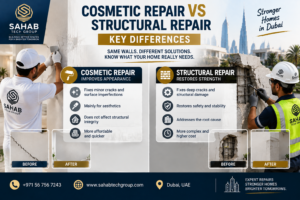
Cosmetic Repair vs Structural Repair: Key Differences
| Factor | Cosmetic Repair | Structural Repair |
|---|---|---|
| Applies to | Hairline & minor surface cracks | Wide, growing, or structural cracks |
| Process | Fill, sand, repaint | Inspection, reinforcement, possible structural work |
| Cost | Lower | Significantly higher |
| Timeline | Quick, often same-day | Can take days to weeks depending on scope |
| Risk if ignored | Low | Potentially serious if left unaddressed |
Understanding which category a crack falls into before starting repairs prevents both unnecessary spending on structural work for a harmless crack, and, more importantly, underestimating a genuine structural issue.
Common Mistakes Homeowners Make with Wall Cracks
Assuming Every Crack Is Harmless
While most cracks are cosmetic, dismissing every crack without closer inspection risks missing early warning signs of a genuine structural issue.
Repainting Over a Crack Without Investigating
Simply painting over a crack hides the visual problem temporarily but does nothing to address the underlying cause, which often reappears through the fresh paint later.
Ignoring Cracks That Are Actively Growing
A crack that widens noticeably over weeks or months signals ongoing movement, which generally warrants a professional look rather than continued monitoring alone.
Not Documenting Crack Progression
Taking dated photos of a crack over time makes it far easier to determine whether it’s stable or actively worsening, information that’s valuable for any professional assessment.
Delaying Inspection After Nearby Construction
Cracks that appear suddenly following nearby excavation or construction activity deserve prompt attention, since ground disturbance can sometimes affect adjacent structures.
A Practical Checklist for Assessing Wall Cracks
- □ Measure the crack’s width and note its location
- □ Check whether it’s confined to plaster or extends into the wall structure
- □ Look for related signs — sticking doors, uneven floors, gaps at frames
- □ Take dated photos to track any changes over time
- □ Monitor for a few weeks if the crack appears minor
- □ Schedule a professional inspection for wide, growing, or structural-pattern cracks
- □ Get a detailed, itemized repair quotation before proceeding
- □ Address the root cause, not just the visible surface crack
How Sahab Tech Group LLC Can Help
Given how much uncertainty surrounds wall cracks, Sahab Tech Group LLC provides crack inspection, assessment, and repair services for villas, apartments, and commercial properties across Dubai.
With 15+ years of industry experience, the team supports property owners with:
- Crack inspection and severity assessment
- Cosmetic crack repair and finishing
- Structural crack investigation
- Reinforcement and structural repair work
- Repainting and texture matching after repair
- Guidance on monitoring cracks over time
Why Choose Sahab Tech Group LLC for Wall Crack Repair?
| What You Need | Sahab Tech Group LLC |
|---|---|
| Experienced inspection team | 15+ years of industry experience |
| Cosmetic & structural repair capability | ✓ |
| Honest, accurate assessments | ✓ |
| Finishing & repainting included | ✓ |
| Transparent, itemized quotations | ✓ |
| Dubai-wide service | ✓ |
Conclusion
Wall cracks are an extremely common part of property ownership in Dubai, largely driven by heat cycles, ground settlement, and natural building movement over time. Most cracks turn out to be harmless and easily fixed with a simple cosmetic repair.
That said, certain warning signs — width, growth over time, sticking doors, or a stair-step pattern — indicate that a crack deserves closer professional attention rather than a quick paint touch-up. Knowing the difference helps homeowners respond appropriately, without either overreacting to a harmless hairline crack or underestimating a genuine structural concern.
If you’ve noticed a crack and aren’t sure which category it falls into, a professional assessment can provide clarity and peace of mind before deciding on repairs.
Contact Sahab Tech Group LLC at +971 56 756 7243 to schedule a wall crack inspection or request a repair quotation.

FAQs
1. Are wall cracks normal in Dubai homes?
Yes, to a large extent — heat cycles, ground settlement, and natural building movement make minor cracks fairly common, and most turn out to be cosmetic rather than structural.
2. How wide does a crack need to be before it’s a concern?
Generally, cracks wider than 3–5mm, or ones that keep growing over time, warrant a professional inspection rather than a simple cosmetic fix.
3. What does a stair-step crack usually indicate?
Stair-step cracks, which follow brick or block joints in a zigzag pattern, can indicate foundation movement, especially when paired with sticking doors or uneven flooring.
4. Can I just paint over a crack instead of repairing it?
Painting over a crack without addressing its cause only hides the problem temporarily, and it often reappears through the new paint if the underlying movement continues.
5. When should I get a professional inspection for a wall crack?
If a crack is wide, actively growing, appears alongside sticking doors or uneven floors, or shows up suddenly after nearby construction, a professional inspection is the safer next step.