
Why Is My AC Making Strange Noises?
Hearing unusual sounds from your cooling system can be stressful during peak summer. Knowing why is my ac making strange noises helps you address minor faults early and maintain efficiency according to DEWA energy guidelines.
Not every noise signals an emergency, though. Some sounds point to a simple, inexpensive fix, while others indicate a component failure that needs prompt attention before it turns into a much larger repair. Learning to tell these apart — rather than either ignoring every sound or panicking at the first click — can save both money and unnecessary worry.
This guide breaks down the most common AC noises, what typically causes each one, how urgently they need attention, and realistic 2026 repair cost estimates for Dubai properties. Understanding why is my ac making strange noises ensures you keep your cooling system running smoothly.

Why AC Noises Happen More Often in Dubai’s Climate
Near-Continuous Operation
Since AC units in Dubai often run for the majority of the day across much of the year, mechanical components experience far more wear than they would in climates with only seasonal cooling.
Dust and Sand Buildup
Airborne dust and sand infiltrate outdoor units constantly, and accumulated debris can interfere with fan blades, coils, and moving parts — often producing rattling or buzzing sounds as a result.
Extreme Heat Stress
High ambient temperatures push compressors and motors to work harder, which can accelerate wear on internal components and occasionally produce unusual noises as parts near the end of their service life.
Infrequent Servicing
When filters, coils, and components go too long without cleaning or inspection, minor issues that would otherwise get caught early can develop into audible mechanical problems.
Given how much strain Dubai’s climate places on AC systems, unusual noises tend to appear sooner here than in less demanding environments — making prompt attention especially worthwhile.
Common AC Noises and What They Usually Mean
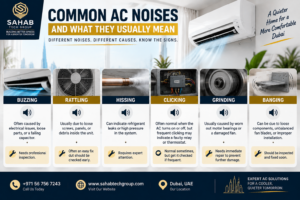
Rattling
A rattling sound often points to loose parts — screws, panels, or debris caught in the outdoor unit’s fan. In many cases, this is a straightforward fix once the source is located.
Buzzing
Buzzing noises frequently indicate an electrical issue, such as a loose wire, failing capacitor, or a component beginning to malfunction. Because this can affect safety and performance, buzzing generally deserves prompt attention.
Clicking
A clicking sound at startup or shutdown is often normal, caused by relays switching on and off. However, continuous or rapid clicking usually signals a faulty component that needs inspection.
Hissing
Hissing frequently points to a refrigerant leak, particularly if it’s accompanied by reduced cooling performance. Since refrigerant leaks can affect both efficiency and system health, this noise generally warrants prompt professional evaluation.
Banging
Loud banging noises often indicate a loose or broken part inside the compressor, such as a disconnected piston pin or a failing motor mount. This typically signals a more serious mechanical issue.
Squealing
A high-pitched squeal commonly relates to a fan motor bearing wearing out, or a belt that’s slipping or damaged. Left unaddressed, this often develops into a complete component failure.
Grinding
Grinding noises usually point to a motor bearing that has failed or is close to failing. This generally requires prompt repair, since continued operation can cause further, more expensive damage.
Humming
A low, steady hum during normal operation is typically nothing to worry about — but a sudden increase in hum volume can indicate strain on the compressor or motor.
AC Noise Guide: Cause and Urgency at a Glance
| Noise Type | Likely Cause | Urgency Level |
|---|---|---|
| Rattling | Loose parts, debris in unit | Low–Moderate |
| Buzzing | Electrical issue, failing capacitor | Moderate–High |
| Clicking (occasional) | Normal relay switching | Low |
| Clicking (continuous) | Faulty component | Moderate |
| Hissing | Refrigerant leak | High |
| Banging | Loose/broken internal part | High |
| Squealing | Worn bearing or belt | Moderate–High |
| Grinding | Failing motor bearing | High |
| Humming (sudden increase) | Compressor/motor strain | Moderate |
When a Noise Is Likely Minor
Some noises, while noticeable, generally don’t indicate an urgent problem:
- Occasional clicking during startup or shutdown
- A consistent, low-level hum during normal operation
- Brief rattling that stops after adjusting a loose panel
- Sounds that don’t affect cooling performance
In these cases, a routine service visit is usually enough to confirm there’s no underlying issue, rather than an emergency callout. Understanding why is my ac making strange noises ensures you keep your cooling system running smoothly.
When a Noise Signals a Serious Problem
By contrast, certain noises point to issues that shouldn’t wait:
- Hissing accompanied by reduced cooling
- Grinding or persistent squealing
- Loud banging from the outdoor unit
- Buzzing paired with the system tripping or shutting off
- Any new noise accompanied by a burning smell
- Noises that grow louder or more frequent over just a few days
If any of these occur, switching off the unit and arranging a professional inspection promptly helps prevent a moderate issue from turning into a costly full breakdown.
What Typically Happens During an AC Noise Diagnosis?
Initial Inspection
A technician first identifies where the noise originates the indoor unit, outdoor unit, or specific component since accurate diagnosis depends on pinpointing the source.
Component Testing
Depending on the suspected cause, the technician checks capacitors, motors, bearings, and electrical connections, often using specialized tools to confirm exactly what’s failing.
Refrigerant Check
If a hissing sound suggests a possible leak, refrigerant levels get tested, and any leak location gets identified before a repair plan is proposed.
Repair or Replacement Recommendation
Finally, the technician recommends either a targeted repair such as replacing a bearing or capacitor or, for older systems with multiple issues, discusses whether replacement makes more financial sense long-term.
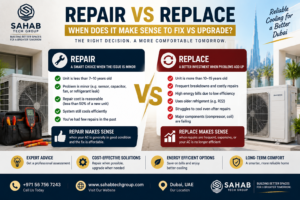
Repair vs Replace: When Does It Make Sense to Fix vs Upgrade?
| Factor | Favor Repair | Favor Replacement |
|---|---|---|
| System age | Under 7 years | Over 10 years |
| Noise cause | Single, isolated component failure | Multiple recurring issues |
| Repair cost | Under 30% of replacement cost | Approaching or exceeding replacement cost |
| Overall condition | Otherwise well-maintained | History of frequent breakdowns |
| Energy efficiency | Reasonably efficient | Noticeably outdated or inefficient |
Generally speaking, an isolated noise issue on a well-maintained, reasonably new system is worth repairing, while an older unit with recurring problems often makes more financial sense to replace rather than repeatedly repair.
Estimated AC Noise Repair Costs in Dubai (2026)
| Issue | Estimated Cost in Dubai (AED) |
|---|---|
| Loose part/panel tightening | 100 – 250 |
| Capacitor replacement | 200 – 500 |
| Fan motor bearing replacement | 300 – 800 |
| Belt replacement (where applicable) | 200 – 500 |
| Refrigerant leak detection & repair | 500 – 2,000+ |
| Compressor repair | 1,000 – 3,500+ |
| Compressor replacement | 2,500 – 6,000+ |
| Full diagnostic visit | 150 – 350 |
*These are indicative estimates only. Actual pricing depends on the system type, root cause, and severity of the issue. A technician assessment remains the most reliable way to obtain an accurate quotation.
Common Mistakes When Dealing with AC Noises
Ignoring the Noise Because Cooling Still Works
A system can continue cooling adequately even while a component is failing, which means waiting until performance drops often allows more damage to accumulate.
Assuming All Noises Are the Same Issue
Different noises point to very different causes, so applying a generic fix without proper diagnosis often fails to resolve the actual underlying problem.
Continuing to Run the Unit After a Burning Smell
Combined with any unusual noise, a burning smell warrants switching the system off immediately and calling a technician, rather than continuing to operate it.
Delaying Service for a Refrigerant Leak
Postponing repair on a suspected refrigerant leak generally worsens both cooling performance and electricity consumption the longer it continues.
Choosing the Cheapest Repair Without Checking the Root Cause
A quick, low-cost fix that doesn’t address the underlying issue often leads to the same noise, and the same repair bill, returning within a few months.
A Practical Checklist When Your AC Starts Making Noise
- □ Identify which unit the noise is coming from (indoor or outdoor)
- □ Note when the noise occurs (startup, shutdown, or continuous)
- □ Check whether cooling performance has changed
- □ Watch for accompanying signs — smells, leaks, or tripping
- □ Switch off the unit if the noise is loud, sudden, or paired with a burning smell
- □ Schedule a professional diagnosis rather than guessing at the cause
- □ Ask for a clear explanation of the root cause before approving repairs
- □ Consider a repair-vs-replace discussion for older systems
How Sahab Tech Group LLC Can Help
Given how many different issues can cause unusual AC sounds, Sahab Tech Group LLC provides AC diagnosis and repair services for villas, apartments, and commercial properties across Dubai.
With 15+ years of industry experience, the team supports property owners with:
- Accurate noise diagnosis and root-cause identification
- Component repair, including motors, capacitors, and bearings
- Refrigerant leak detection and repair
- Compressor repair and replacement
- Honest repair-vs-replace guidance for older systems
- Emergency response for urgent AC issues
Why Choose Sahab Tech Group LLC for AC Noise Repair?
| What You Need | Sahab Tech Group LLC |
|---|---|
| Experienced HVAC technicians | 15+ years of industry experience |
| Accurate diagnosis before repair | ✓ |
| Residential & commercial coverage | ✓ |
| Emergency response support | ✓ |
| Transparent, itemized quotations | ✓ |
| Dubai-wide service | ✓ |
Conclusion
Strange AC noises are rarely something to ignore, though not every sound signals a crisis. A soft click at startup or a brief rattle after a loose panel usually needs nothing more than a routine check, while hissing, grinding, or loud banging generally call for prompt professional attention before the issue worsens.
Understanding what each noise typically means, along with realistic repair cost expectations, helps property owners respond appropriately — addressing genuine problems quickly while avoiding unnecessary panic over minor, harmless sounds.
If your AC has started making an unfamiliar noise and you’re not sure how urgent it is, a professional diagnosis can provide clarity before the problem grows into something more costly.
Contact Sahab Tech Group LLC at +971 56 756 7243 to schedule an AC inspection or repair.

FAQs
1. Is it normal for an AC to make some noise?
Yes, a consistent low hum during operation and occasional clicking at startup or shutdown are generally normal. New, loud, or continuous noises, however, usually warrant a closer look.
2. What does a hissing sound from my AC usually mean?
Hissing most often points to a refrigerant leak, particularly when paired with reduced cooling performance, and generally deserves prompt professional evaluation.
3. Should I turn off my AC if it starts making a loud banging noise?
Yes — loud banging often indicates a serious internal issue, so switching off the unit and arranging an inspection helps prevent further damage.
4. Can a noisy AC still cool the room properly?
Sometimes, yes, at least initially. However, a failing component can continue to work for a while before performance drops, so an early noise is worth investigating rather than waiting for cooling to decline.
5. How do I know if I should repair or replace a noisy AC unit?
Generally, if the system is under seven years old with an isolated issue, repair makes sense. Older units with recurring problems or repair costs approaching replacement value often make more sense to upgrade. Understanding why is my ac making strange noises ensures you keep your cooling system running smoothly.