
Central AC vs Split AC for Dubai Homes
When it comes to cooling a Dubai home, few decisions matter as much as choosing between a central AC system and split AC units. This choice affects everything from upfront cost and installation complexity to long-term energy bills and how evenly a home stays cooled throughout the year.
Both systems can cool a Dubai home effectively, but they suit different property types, budgets, and priorities. A villa undergoing new construction has very different options available compared to an apartment owner looking to replace an aging unit, which is why understanding the practical differences matters more than simply picking whichever system sounds more advanced.
This guide compares central AC and split AC systems across performance, cost, installation, and maintenance, along with realistic 2026 pricing to help homeowners make an informed decision — whether planning a new build, renovating an existing property, or simply replacing an aging system that’s due for an upgrade. Choosing the right AC in dubai is crucial.

What Is a Central AC System?
A central air conditioning system cools an entire property through a single, centralized unit connected to a network of ducts that distribute cool air to every room. Rather than cooling room by room, it treats the home as one integrated system, with a thermostat typically controlling overall temperature.
Central systems are common in larger villas, particularly those built with ducted infrastructure already in place. Because the entire home shares one system, central AC generally delivers more consistent temperatures across multiple rooms simultaneously. Choosing the right AC in dubai is crucial.
What Is a Split AC System?
A split AC system, by contrast, consists of individual units — each with an indoor unit mounted on a wall and a corresponding outdoor condenser — installed in specific rooms or zones. Each unit operates independently, meaning a bedroom can be cooled without running the AC in unused areas of the home.
Split systems are widely used in apartments, smaller villas, and properties without existing ductwork, largely because they’re easier to install without major structural work.
Key Differences Between Central AC and Split AC
Cooling Coverage and Consistency
Central AC generally provides more even cooling across an entire property, since one system manages the whole home simultaneously. Split AC, meanwhile, allows more precise room-by-room control, which can be more efficient if certain rooms are used far less than others.
Installation Requirements
Central AC installation is significantly more involved, requiring ductwork throughout the property — a major undertaking in an existing home without existing ducts. Split AC installation, by comparison, is considerably simpler, since each unit only needs a small wall opening and outdoor unit placement.
Noise Levels
Split AC units tend to be quieter indoors, since the noisier compressor component sits outside the building. Central systems, depending on design and ductwork quality, can sometimes produce more noticeable airflow noise through vents.
Aesthetic Impact
Central AC keeps rooms visually clean, since no indoor units are visible — only discreet vents in ceilings or walls. Split AC units, on the other hand, remain visible on walls in every room they cool, which some homeowners consider less aesthetically pleasing.
Zoning and Flexibility
Split systems offer natural zoning, since each unit can be switched on or off independently. Central systems can achieve zoning too, but only with additional zoning dampers and controls, which add cost and complexity.
Energy Efficiency
Efficiency depends heavily on usage patterns. If only a few rooms need cooling at any given time, split AC units often use less energy overall, since unused rooms aren’t cooled unnecessarily. Central AC can be efficient for whole-home cooling but may waste energy cooling unoccupied rooms unless zoning is installed.
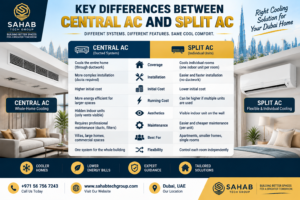
Comparing Central AC and Split AC at a Glance
| Factor | Central AC | Split AC |
|---|---|---|
| Cooling coverage | Whole-home, consistent | Room-by-room, independent |
| Installation complexity | High (requires ductwork) | Low to moderate |
| Best suited for | New builds, larger villas | Apartments, smaller villas, retrofits |
| Visible indoor units | No (vents only) | Yes, one per room |
| Noise level | Moderate (airflow through vents) | Lower indoors |
| Zoning flexibility | Requires additional dampers | Built-in by design |
| Typical lifespan | 15–20 years | 10–15 years |
| Relative upfront cost | Higher | Lower per unit, scales with room count |
Which System Suits Which Property Type?
New Villa Construction
For villas being built from scratch, central AC is often the more practical long-term choice, since ductwork can be planned into the design from the outset without the retrofit challenges that come later.
Existing Villas Without Ductwork
Retrofitting central AC into an existing villa without ducts involves substantial construction work, which is why many owners in this situation opt for split systems, or a ducted mini-split as a middle ground.
Apartments
Since apartments rarely have space for extensive ductwork, split AC remains the standard and most practical choice for the vast majority of units.
Multi-Story Villas with Varying Usage
Villas where certain floors or rooms see far less use than others often benefit from split systems, since cooling can be limited to occupied areas rather than the entire property at once. This approach also makes it easier to adjust cooling patterns seasonally, such as closing off a guest floor during quieter months.

What Affects the Cost of Each System?
Central AC Cost Factors
- Property size and number of rooms requiring ductwork
- Ductwork installation complexity (new build vs retrofit)
- System capacity (tonnage) required for the property
- Zoning requirements, if desired
- Ceiling type and accessibility for duct routing
Split AC Cost Factors
- Number of units needed
- Capacity (BTU) required per room
- Brand and energy efficiency rating
- Installation complexity, including outdoor unit placement
- Piping distance between indoor and outdoor units
Because these cost drivers differ so significantly between the two systems, comparing quotations side by side only makes sense once property-specific requirements are properly assessed.
Estimated AC System Costs in Dubai (2026)
| System | Estimated Cost in Dubai (AED) |
|---|---|
| Split AC unit (1.5–2 ton, per unit installed) | 2,500 – 5,000 |
| Split AC – full villa (6–8 units) | 20,000 – 45,000+ |
| Central AC – new build (average villa) | 40,000 – 90,000+ |
| Central AC – retrofit into existing villa | 60,000 – 130,000+ |
| Ductwork installation/repair (per project) | Highly dependent on scope |
| Zoning system add-on (central AC) | 5,000 – 15,000+ |
*These are indicative estimates only. Actual pricing depends on property size, system capacity, ductwork condition, and installation complexity. A professional site assessment remains the most reliable way to obtain an accurate quotation.
Maintenance Differences Between Central and Split AC
| Factor | Central AC | Split AC |
|---|---|---|
| Filter access | Often centralized, easier to manage | Per-unit, more filters to maintain |
| Duct cleaning | Required periodically | Not applicable |
| Servicing complexity | Single system, larger scope per visit | Multiple smaller units, individually serviced |
| Repair cost if one component fails | Can affect whole-home cooling | Typically isolated to one room |
One practical advantage of split systems is fault isolation — if one unit fails, the rest of the home continues cooling normally, whereas a central system fault can affect the entire property at once.
Common Mistakes When Choosing Between Central and Split AC
Choosing Central AC for a Property Without Planning for Ductwork
Retrofitting ductwork into an already-finished home often costs far more than anticipated, and skipping proper planning can lead to compromised ceiling heights or exposed ducting.
Undersizing a Split AC System
Installing an undersized unit for a room’s actual size and heat load leads to poor cooling performance and higher energy consumption from constant strain.
Ignoring Long-Term Usage Patterns
Choosing a system based only on upfront cost, without considering how the property will actually be used day to day, often results in inefficient cooling or unnecessary expense down the line.
Overlooking Noise Considerations
Bedrooms and quiet living spaces benefit from careful system selection, since indoor unit noise varies meaningfully between brands and system types.
Not Comparing Long-Term Energy Costs
Focusing solely on installation price while ignoring long-term energy efficiency often costs more over the system’s lifespan than the initial savings suggested.
A Practical Checklist Before Choosing Your AC System
- □ Assess whether ductwork already exists or would need retrofitting
- □ Determine which rooms need consistent cooling vs occasional use
- □ Compare upfront cost against long-term energy efficiency
- □ Consider noise levels for bedrooms and quiet spaces
- □ Factor in property type (villa vs apartment) and its practical constraints
- □ Request quotations for both system types where feasible
- □ Ask about zoning options if choosing central AC
- □ Confirm warranty and maintenance support for either system
How Sahab Tech Group LLC Can Help
Given how much this decision affects long-term comfort and cost, Sahab Tech Group LLC provides both central and split AC installation, servicing, and repair for villas, apartments, and commercial properties across Dubai.
With 15+ years of industry experience, the team supports property owners with:
- System assessment and sizing recommendations
- Central AC design and ductwork installation
- Split AC unit installation and replacement
- Zoning system installation for central AC
- Ongoing servicing and maintenance for both system types
- Honest guidance on which system fits your property
Why Choose Sahab Tech Group LLC for AC Installation?
| What You Need | Sahab Tech Group LLC |
|---|---|
| Experienced HVAC team | 15+ years of industry experience |
| Central & split AC expertise | ✓ |
| Ductwork design & installation | ✓ |
| Honest system recommendations | ✓ |
| Transparent, itemized quotations | ✓ |
| Dubai-wide service | ✓ |
Conclusion
Neither central AC nor split AC is universally better — the right choice depends on the property, budget, and how the space actually gets used. Central AC suits new villa construction and larger homes wanting consistent whole-property cooling, while split AC remains the practical choice for apartments, retrofits, and properties where room-by-room control matters more than uniform coverage.
Understanding these differences, along with realistic cost expectations, helps homeowners choose a system that fits both their property and their long-term budget, rather than defaulting to whichever option seems more common.
If you’re planning a new installation or considering a system upgrade, professional guidance can help clarify which option genuinely suits your home.
Contact Sahab Tech Group LLC at +971 56 756 7243 to discuss your AC system options or request a professional quotation.

FAQs
1. Is central AC better than split AC for a Dubai villa?
Not necessarily — central AC often suits new villa construction with planned ductwork, while split AC can be more practical and cost-effective for existing villas without ducts already in place.
2. Which system costs more to install?
Generally, central AC costs significantly more upfront, particularly for retrofits, while split AC costs scale more gradually based on the number of units required.
3. Is split AC or central AC more energy-efficient?
It depends on usage. Split AC can be more efficient when only certain rooms need cooling at a time, while central AC works well for consistent whole-home cooling.
4. Can I install central AC in an apartment?
Rarely — most apartments lack the space and structural allowance for ductwork, which is why split AC remains the standard choice for the vast majority of units.
5. Which system is easier to maintain?
Split AC units are generally simpler to service individually, and a fault in one unit doesn’t affect the rest of the home, whereas central AC issues can impact whole-property cooling until resolved.