
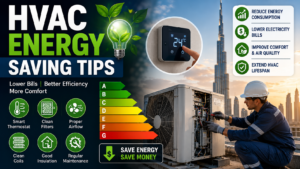
HVAC Energy Saving Tips Practical Ways to Reduce Cooling Costs and Improve Efficiency
Following practical HVAC energy saving tips is the best way to lower electricity costs while keeping indoor spaces comfortable. Keeping a building cool can consume a significant amount of electricity, especially in a hot climate like Dubai. For homes, offices, retail spaces, warehouses, hotels, restaurants, and industrial facilities, air conditioning is often one of the largest sources of energy consumption.
However, high HVAC energy consumption does not always mean you need a completely new air-conditioning system. In many cases, inefficient settings, dirty components, poor airflow, leaking ducts, inadequate insulation, or irregular maintenance can cause an HVAC system to work much harder than necessary.
The good news is that many of these problems can be corrected.
By making a combination of small operational changes and targeted maintenance improvements, property owners can reduce unnecessary HVAC energy consumption, improve indoor comfort, and potentially lower electricity costs. Following these HVAC energy saving tips helps reduce monthly bills and improves system life.
In this guide, we will cover practical HVAC Energy Saving Tips for residential, commercial, and industrial properties. We will also explain why HVAC systems consume so much energy, what causes efficiency losses, how Dubai’s climate affects cooling demand, and which improvements can provide the greatest potential savings.
How Does an HVAC System Use Energy?
Before discussing ways to save energy, it is useful to understand where the energy actually goes.
An HVAC system does more than simply produce cold air. Depending on the system, electricity may be used by:
- Compressors
- Condenser fans
- Evaporator fans
- Air-handling units
- Pumps
- Controls
- Thermostats
- Ventilation equipment
- Auxiliary components
The compressor is particularly important because it can consume a substantial portion of the electricity required for cooling.
When an HVAC system is operating efficiently, these components work together to remove heat from the indoor environment without unnecessary energy consumption.
However, when airflow is restricted, coils become dirty, refrigerant levels are incorrect, ducts leak, or the system is poorly maintained, the equipment may need to operate for longer periods to achieve the same temperature. Following these HVAC energy saving tips helps reduce monthly bills and improves system life.
Consequently, poor HVAC efficiency can increase both electricity consumption and operating costs.
Why HVAC Energy Consumption Is High in Dubai
Dubai’s climate presents a unique challenge for cooling systems.
During the hotter months, outdoor temperatures can become extremely high, while humidity can also increase the cooling load on buildings. As a result, HVAC systems may operate for long periods every day.
Several factors contribute to this high cooling demand.
Extreme Outdoor Temperatures
The greater the difference between indoor and outdoor temperatures, the harder an HVAC system generally has to work.
For example, maintaining a comfortable indoor environment while outdoor temperatures are extremely high requires continuous heat removal. Following these HVAC energy saving tips helps reduce monthly bills and improves system life.
Solar Heat Gain
Sunlight entering through windows, glass façades, roofs, and poorly insulated walls can transfer significant heat into a building.
This is known as solar heat gain.
Large windows with direct sunlight can therefore increase the workload placed on the air-conditioning system.
Long Cooling Seasons
In colder climates, air conditioning may only be necessary for a few months each year.
Dubai properties, however, can require cooling for much longer periods. Therefore, even relatively small efficiency losses can accumulate into significant annual energy consumption.
Humidity
HVAC systems do not only cool the air. They also help control indoor humidity.
When humidity levels are high, air conditioning may need to operate longer to maintain comfortable indoor conditions.
Therefore, controlling humidity is another important part of HVAC energy efficiency.
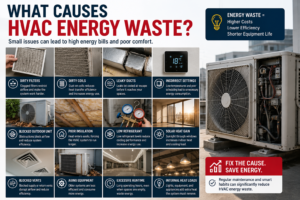
What Causes HVAC Energy Waste?
An HVAC system can consume more energy than necessary for many different reasons.
Some problems are related to the equipment itself, while others result from how the building is operated.
The most common causes include:
- Dirty air filters
- Dirty evaporator or condenser coils
- Poor airflow
- Leaking air ducts
- Incorrect refrigerant levels
- Poor insulation
- Incorrect thermostat settings
- Excessive AC runtime
- Oversized or undersized equipment
- Poor preventive maintenance
- Heat entering through windows and doors
- Blocked vents
- Aging HVAC equipment
- Poor ventilation management
- High indoor humidity
Fortunately, many of these problems can be addressed without replacing the entire HVAC system.
15 Practical HVAC Energy Saving Tips
1. Set the Thermostat to a Reasonable Temperature
One of the simplest ways to reduce HVAC energy consumption is to avoid unnecessarily low temperature settings.
Setting the thermostat significantly lower does not necessarily make a room cool proportionally faster. Instead, it can cause the HVAC system to run for longer periods.
A more reasonable temperature setting can reduce unnecessary cooling demand while still maintaining indoor comfort.
For commercial properties, the ideal temperature should also consider occupancy, equipment loads, working conditions, and building use.
2. Replace or Clean Air Filters Regularly
Air filters are designed to capture dust and airborne particles before they enter the HVAC system.
However, as filters become clogged, airflow can become restricted.
The system then has to work harder to circulate air throughout the property.
Regular filter inspection and replacement can therefore help:
- Improve airflow
- Reduce system strain
- Maintain indoor air quality
- Improve cooling performance
- Reduce unnecessary energy consumption
How frequently filters should be replaced depends on the system, filter type, occupancy, dust levels, and operating conditions.
3. Keep Evaporator and Condenser Coils Clean
Dirty coils can significantly affect HVAC performance.
The evaporator coil is responsible for absorbing heat from indoor air, while the condenser coil releases heat outside.
When dust and debris accumulate on these components, heat transfer becomes less efficient.
As a result, the system may need to run longer to achieve the same cooling effect.
Regular professional cleaning can therefore be an important part of an HVAC energy saving strategy.
4. Check Airflow
Good airflow is essential for efficient cooling.
Blocked vents, dirty filters, damaged ductwork, or incorrectly balanced air distribution can prevent conditioned air from reaching rooms effectively.
If some rooms are consistently warmer than others, the problem may not simply be the thermostat.
It could indicate:
- Restricted airflow
- Duct problems
- Poor insulation
- Incorrect system balancing
- Equipment issues
Addressing the underlying cause is usually more effective than simply lowering the thermostat.
5. Inspect Ductwork for Air Leaks
Air ducts transport conditioned air throughout a building. If ducts have gaps, cracks, loose connections, or damaged insulation, cooled air can escape before reaching its intended destination.
This means the HVAC system may produce more cooling than the building actually receives.
Professional duct inspection and sealing can improve distribution efficiency and reduce unnecessary system runtime.
This is particularly important in larger commercial and industrial properties where duct networks can be extensive.
6. Maintain Correct Refrigerant Levels
Refrigerant plays a critical role in the cooling process.
If the system has insufficient refrigerant because of a leak or another technical issue, its cooling performance can deteriorate.
The HVAC system may then operate longer while struggling to achieve the desired temperature.
However, refrigerant should not simply be added without investigating the reason for low levels.
If a leak exists, the underlying problem should be diagnosed and repaired first.
7. Keep Outdoor Units Clear
Outdoor condenser units need adequate airflow to release heat efficiently.
Avoid placing objects, storage materials, vegetation, or other obstructions directly around the unit.
Restricted airflow can increase operating pressure and reduce heat-transfer efficiency.
Regularly checking the area around outdoor equipment is a simple maintenance step that can support better HVAC performance.
8. Use Curtains and Blinds to Reduce Heat Gain
Windows can allow substantial amounts of solar heat into a building.
During periods of intense sunlight, curtains, blinds, shades, or other appropriate window treatments can help reduce direct heat gain.
This is especially useful for:
- Bedrooms
- Offices
- Meeting rooms
- Retail spaces
- Glass-fronted buildings
Reducing the amount of heat entering the building means the HVAC system has less heat to remove.
9. Improve Building Insulation
Insulation helps slow the transfer of heat between the interior and exterior of a building.
Poorly insulated roofs, walls, and ceilings can allow outdoor heat to enter more easily.
Consequently, the HVAC system must work harder to maintain the desired indoor temperature.
Improving insulation can therefore support both comfort and long-term energy efficiency.
10. Keep Doors and Windows Closed While Cooling
An open door or window allows conditioned air to escape while warm and humid outdoor air enters.
This creates an unnecessary cooling load.
For homes, offices, restaurants, shops, and other air-conditioned spaces, keeping doors and windows properly closed during active cooling can help maintain indoor conditions more efficiently.
Automatic doors or door closers can also be useful in high-traffic commercial environments.
11. Avoid Blocking Supply and Return Vents
Furniture, storage materials, curtains, or other objects can sometimes obstruct HVAC vents.
When airflow is blocked, conditioned air cannot circulate properly.
Therefore, keep supply and return vents clear and avoid placing large objects directly in front of them.
This simple adjustment can improve air circulation without requiring additional cooling capacity.
12. Use HVAC Scheduling
Not every area of a building requires the same amount of cooling throughout the entire day.
For example, an office may have significantly lower occupancy outside working hours.
Similarly, a retail shop may have different cooling requirements before opening and after closing.
Using programmable schedules can reduce unnecessary HVAC operation during periods when spaces are unoccupied.
This can be particularly valuable for commercial buildings with predictable operating hours.
13. Control Humidity Properly
Humidity affects both comfort and HVAC performance.
If indoor humidity remains excessively high, occupants may feel uncomfortable even when the temperature appears reasonable.
As a result, people may lower the thermostat unnecessarily.
Maintaining appropriate humidity levels can therefore help occupants feel comfortable without demanding excessive cooling.
14. Schedule Preventive HVAC Maintenance
Preventive maintenance is one of the most important long-term HVAC Energy Saving Tips.
Instead of waiting for the system to break down, regular maintenance allows technicians to identify developing problems before they become major efficiency issues.
A professional maintenance program may include:
- Filter inspection
- Coil cleaning
- Electrical inspection
- Refrigerant checks
- Drain inspection
- Airflow testing
- Thermostat inspection
- Ductwork assessment
- Component inspection
- Performance testing
Regular maintenance can also extend equipment life and reduce the likelihood of unexpected breakdowns.
15. Consider HVAC Replacement When Efficiency Has Declined Significantly
Maintenance can solve many HVAC problems, but it cannot make an aging or severely inefficient system perform like a modern high-efficiency unit.
If your HVAC system is:
- Very old
- Frequently breaking down
- Consuming significantly more electricity
- Struggling to maintain temperature
- Requiring repeated expensive repairs
then replacement may eventually become more economical than continued repairs.
However, replacement should not be based solely on age.
A proper assessment should consider the system’s efficiency, operating costs, repair history, capacity, condition, and expected remaining service life.
For more information about the warning signs that indicate replacement may be appropriate, readers can also refer to our related guide on “Signs Your HVAC Needs Replacement.”
Which HVAC Energy Saving Tips Usually Have the Biggest Impact?
Not every improvement produces the same level of savings.
The potential impact depends on the property’s size, HVAC equipment, operating schedule, climate exposure, maintenance history, and existing efficiency.
Generally, the most meaningful improvements often involve correcting problems that force the system to operate unnecessarily.
| Improvement | Potential Impact |
|---|---|
| Regular preventive maintenance | Medium to High |
| Correcting duct leaks | Medium to High |
| Improving insulation | Medium to High |
| Cleaning coils | Low to Medium |
| Replacing clogged filters | Low to Medium |
| Optimizing thermostat settings | Low to Medium |
| Reducing solar heat gain | Medium |
| Correcting refrigerant problems | Medium to High |
| Improving airflow | Medium |
| Replacing highly inefficient equipment | High |
These categories should not be treated as guaranteed savings percentages. Actual results depend heavily on the existing condition of the HVAC system and building.
A Simple Rule: Fix Waste Before Buying New Equipment
One of the most important lessons when improving HVAC energy efficiency is that you should not automatically replace equipment before identifying where energy is being wasted.
For example, imagine a building with:
- Dirty coils
- Leaking ducts
- Poor insulation
- Blocked airflow
- Incorrect thermostat settings
Replacing the HVAC unit without correcting these building-related problems may not deliver the expected results.
The new system could still operate inefficiently because the underlying cooling load and distribution problems remain.
Therefore, a better approach is usually:
Inspect → Identify inefficiencies → Correct problems → Measure performance → Consider replacement if necessary
This approach can help property owners spend money where it produces the greatest practical benefit.
What Should You Do First?
If you want to reduce HVAC energy consumption, start with the simple things.
Quick HVAC Energy-Saving Checklist
- □ Check the air filter
- □ Inspect thermostat settings
- □ Keep vents unobstructed
- □ Check doors and windows
- □ Inspect outdoor unit clearance
- □ Look for unusual system noises
- □ Check for weak airflow
- □ Monitor unusual increases in electricity bills
- □ Schedule professional maintenance
- □ Inspect ductwork
- □ Check insulation
- □ Investigate refrigerant issues
- □ Evaluate system performance before considering replacement
These basic steps can help identify whether your HVAC system is operating normally or wasting energy.
Why HVAC Efficiency Requires More Than the AC Unit
It is easy to think of HVAC efficiency as an equipment problem. However, the building itself plays a major role.
Consider two identical air-conditioning systems installed in two different buildings.
Building A has:
- Good insulation
- Properly sealed ducts
- Efficient windows
- Minimal air leakage
- Regular maintenance
Building B has:
- Poor insulation
- Leaking ducts
- Direct solar exposure
- Frequently open doors
- Dirty filters
Even though the HVAC equipment is identical, Building B will likely require more cooling energy to maintain similar indoor conditions.
Therefore, effective energy management should consider the entire building, not just the air-conditioning equipment.
Advanced HVAC Energy Saving Strategies
The basic HVAC energy-saving measures discussed in Part 1 can make a noticeable difference, but larger properties often require a more detailed approach.
For villas, offices, retail spaces, hotels, warehouses, and industrial buildings, energy efficiency depends on how the HVAC equipment interacts with the building, occupancy, ventilation, insulation, and operating schedule.
Therefore, simply lowering the thermostat or replacing filters may not be enough.
The following strategies can help property owners and facility managers identify deeper sources of HVAC energy waste.
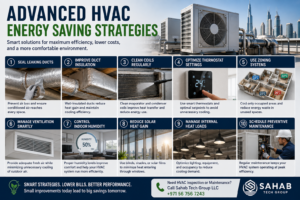
16. Seal Leaking Air Ducts
Ductwork is essentially the transportation network of an HVAC system. Conditioned air travels through ducts before reaching individual rooms and occupied areas.
However, if the ductwork contains gaps, damaged joints, loose connections, or deteriorated insulation, some of that conditioned air can escape.
This creates an efficiency problem.
The HVAC system may produce a certain amount of cooling, but only part of it reaches the intended space.
Common signs of duct problems include:
- Weak airflow from vents
- Rooms that remain warmer than others
- Excessive dust
- Unusual whistling sounds
- High cooling costs
- Long HVAC operating cycles
- Damaged or loose duct insulation
Professional duct inspection can identify areas where conditioned air is being lost.
For larger buildings, duct sealing can be particularly valuable because even relatively small leaks can become significant when multiplied across an extensive duct network.
17. Improve Duct Insulation
Duct leakage is not the only duct-related problem.
Poor insulation can also allow heat to enter conditioned air as it travels through the building.
This is particularly important in hot environments such as Dubai, where ducts may pass through:
- Ceiling voids
- Roof spaces
- Service areas
- Hot mechanical rooms
- Exterior zones
If a cold air duct passes through a very hot area without sufficient insulation, the temperature difference can reduce cooling efficiency.
Consequently, proper duct insulation helps preserve the cooling produced by the HVAC system until it reaches the occupied space.
18. Clean the Evaporator Coil
The evaporator coil absorbs heat from indoor air.
Over time, dust and contaminants can accumulate on the coil surface.
This layer can interfere with heat transfer and restrict airflow.
As a result, the HVAC system may need to run longer to achieve the desired temperature.
Regular coil cleaning can therefore support:
- Better heat transfer
- Improved airflow
- More consistent cooling
- Reduced system strain
- Better overall HVAC efficiency
However, coil cleaning should be performed using appropriate methods and equipment to avoid damaging delicate fins or components.
19. Maintain the Condenser Coil
The outdoor condenser coil releases heat extracted from the building.
Because it is located outdoors, it can accumulate:
- Dust
- Sand
- Dirt
- Leaves
- Debris
When the condenser coil becomes heavily contaminated, the system may struggle to reject heat efficiently.
This can increase operating pressure and place additional stress on the compressor.
Regular condenser maintenance is therefore particularly important in dusty environments.
20. Check Refrigerant Performance
Refrigerant is an essential part of the cooling cycle.
However, low refrigerant levels should not automatically be treated as a routine maintenance issue.
If refrigerant is consistently low, there may be a leak somewhere in the system.
Simply adding refrigerant without identifying the underlying problem may provide only a temporary improvement.
A professional HVAC technician should assess:
- Refrigerant pressure
- System performance
- Possible leakage
- Temperature differential
- Compressor operation
- Overall cooling performance
Correcting refrigerant-related problems can help restore proper system efficiency.
21. Optimize Thermostat Settings
Thermostat management is one of the easiest ways to reduce unnecessary cooling.
However, thermostat optimization does not mean making the building uncomfortable.
Instead, the goal is to match the temperature setting with:
- Occupancy
- Outdoor conditions
- Building usage
- Working hours
- Room requirements
For example, a commercial office that remains empty overnight does not necessarily need the same cooling level as it does during working hours.
Programmable or smart controls can help automate these changes.
22. Use Zoning Where Appropriate
Large buildings rarely have identical cooling requirements throughout every area.
A conference room, storage room, office, corridor, and server room may all have different cooling demands.
A zoning approach allows different areas to be controlled according to their individual requirements.
This can prevent a situation where the entire building is cooled heavily simply because one area requires additional cooling.
Zoning can be especially useful for:
- Large villas
- Offices
- Hotels
- Retail buildings
- Commercial properties
- Multi-use facilities
However, zoning should be properly designed. Poorly implemented zoning can create airflow or pressure problems.
23. Reduce Unnecessary Ventilation Energy
Ventilation is important for indoor air quality, but excessive uncontrolled ventilation can increase cooling demand.
When hot outdoor air enters a building, the HVAC system has to cool and dehumidify it.
This is particularly relevant in Dubai’s climate.
Therefore, ventilation systems should be designed and operated according to the building’s actual requirements.
The objective is not to eliminate ventilation.
Instead, the goal is to provide the necessary fresh air while avoiding unnecessary cooling loads.
24. Manage Indoor Heat Sources
Air conditioning does not only remove heat entering from outside.
It also removes heat generated inside the building.
Common internal heat sources include:
- Computers
- Servers
- Lighting
- Cooking equipment
- Industrial machinery
- Refrigeration equipment
- Large appliances
- Occupants
In commercial and industrial facilities, internal heat loads can become substantial.
Therefore, improving energy efficiency may require looking beyond the HVAC system itself.
For example, heat-generating equipment can sometimes be relocated, insulated, better ventilated, or operated more efficiently.
25. Reduce Solar Heat Gain
Solar heat gain can place a considerable load on cooling systems.
This is particularly important for buildings with:
- Large glass façades
- South- or west-facing windows
- Skylights
- Poorly shaded windows
- Dark exterior surfaces
Possible strategies include:
- Curtains
- External shading
- Solar-control glazing
- Window films
- Proper insulation
- Architectural shading
Reducing heat entering the building means the HVAC system has less work to do.
26. Maintain Proper Drainage
HVAC systems produce condensation during normal operation.
If condensate drains become blocked, water can accumulate around the equipment.
Although drainage problems are primarily a maintenance concern, they can also indicate that the system is not operating correctly.
Regular inspection can help prevent:
- Water damage
- Mould growth
- Drain blockages
- Unnecessary system shutdowns
- Indoor humidity problems
This is another reason why HVAC maintenance should be treated as part of broader property maintenance rather than an isolated service.
27. Monitor HVAC Performance
You cannot effectively manage energy consumption if you never measure it.
Property owners and facility managers should monitor changes in:
- Electricity consumption
- HVAC runtime
- Indoor temperature
- Humidity
- Airflow
- Maintenance frequency
- Repair costs
If electricity consumption suddenly increases without a major change in occupancy or weather conditions, it may indicate that the HVAC system is losing efficiency.
Early investigation can prevent a minor performance issue from becoming an expensive equipment failure.
Residential vs Commercial HVAC Energy Saving
Energy-saving strategies can vary depending on the type of property.
A small apartment does not have the same requirements as a hotel, warehouse, or office building.
| Factor | Residential Property | Commercial Property |
|---|---|---|
| Operating Hours | Often variable | Usually scheduled |
| Occupancy | Lower and variable | Often higher |
| HVAC Size | Smaller systems | Larger systems |
| Zoning | Useful in larger homes | Often highly beneficial |
| Duct Network | Usually smaller | Can be extensive |
| Maintenance | Periodic | Often scheduled regularly |
| Energy Monitoring | Basic to moderate | More detailed |
| Heat Loads | Appliances and occupants | Equipment, people, lighting, machinery |
| Control Systems | Thermostats | Advanced building controls may be used |
The underlying principle remains the same:
Only use as much cooling as the building actually needs.

HVAC Energy Saving for Commercial Buildings
Commercial properties often have greater opportunities for energy savings because of their size and operating schedules.
An office building, for example, may have dozens or hundreds of occupants, multiple HVAC zones, computer equipment, lighting systems, and extensive ductwork.
Several strategies can therefore work together.
Adjust Operating Schedules
HVAC systems should align with actual building occupancy whenever practical.
Running full cooling capacity when a building is mostly empty wastes energy.
Maintain Air-Handling Units
Air-handling units should be inspected regularly for:
- Filter condition
- Coil cleanliness
- Fan performance
- Belt condition
- Airflow
- Drainage
- Control operation
Inspect Duct Systems
Large duct networks should be periodically assessed for leakage, insulation deterioration, and airflow imbalance.
Use Building Controls
Advanced control systems can help facility managers monitor and adjust HVAC operation according to:
- Occupancy
- Temperature
- Humidity
- Time
- Zone requirements
HVAC Energy Saving for Industrial Facilities
Industrial buildings can present a different challenge because HVAC systems may need to manage significant heat loads generated by machinery and production processes.
Energy-saving measures may include:
- Separating conditioned and non-conditioned zones
- Improving industrial ventilation
- Managing process heat
- Optimizing equipment schedules
- Maintaining cooling equipment
- Improving insulation
- Monitoring energy consumption
- Using appropriate zoning
For industrial facilities, energy optimization should be designed around the specific operation of the facility rather than applying generic residential strategies.
HVAC Energy-Saving Myths vs Facts
There are many misconceptions about air conditioning and energy consumption.
Let’s separate some common claims from reality.
| Myth | Fact |
|---|---|
| Setting the AC extremely low cools a room much faster | A lower thermostat setting does not necessarily make the system cool proportionally faster |
| Bigger AC units are always better | Oversized systems can cycle inefficiently and may not control humidity properly |
| If the AC is cooling, maintenance isn’t necessary | An operating system can still lose efficiency over time |
| Closing every vent in unused rooms saves energy | Excessive vent closure can affect airflow and system balance |
| Turning the AC off is always the cheapest option | It depends on the property, duration, outdoor conditions, and system |
| Adding refrigerant always fixes poor cooling | Low refrigerant may indicate a leak that needs to be repaired |
| Filters only affect air quality | Dirty filters can also restrict airflow and increase system workload |
| A new AC automatically solves energy problems | Building insulation, ducts, controls, and heat gain still affect efficiency |
Signs Your HVAC System May Be Wasting Energy
An inefficient HVAC system does not always fail suddenly.
Often, it provides subtle warning signs first.
1. Electricity Bills Keep Increasing
If cooling costs continue increasing without a comparable change in occupancy, usage, or weather, the HVAC system may require inspection.
2. The System Runs Almost Continuously
Long operating cycles can be normal during extreme weather. However, if the system consistently struggles to maintain the desired temperature under ordinary conditions, something may be wrong.
Possible causes include:
- Dirty coils
- Poor insulation
- Refrigerant issues
- Duct leakage
- Incorrect equipment sizing
- Restricted airflow
3. Rooms Have Different Temperatures
If one room is freezing while another remains warm, the problem may involve airflow distribution, ductwork, insulation, zoning, or equipment performance.
4. Airflow Is Weak
Weak airflow can indicate:
- Dirty filters
- Blocked ducts
- Fan problems
- Duct leakage
- Coil contamination
5. The System Frequently Cycles On and Off
Frequent short cycling can reduce comfort and increase mechanical wear.
It may be caused by:
- Incorrect sizing
- Thermostat problems
- Restricted airflow
- Control issues
- Equipment faults
6. Unusual Noises
Grinding, rattling, squealing, or persistent buzzing should not be ignored.
Unusual sounds may indicate mechanical problems that could eventually affect performance and energy consumption.
7. Indoor Humidity Remains High
If rooms feel damp even when the temperature seems acceptable, the HVAC system may not be controlling humidity effectively.
This can be related to equipment performance, sizing, airflow, or other building conditions.
When Should You Consider HVAC Maintenance?
A common mistake is waiting until the HVAC system stops working before arranging maintenance.
Preventive maintenance is fundamentally different from emergency repair.
With preventive maintenance, the goal is to identify and correct developing issues before they cause:
- Higher energy consumption
- Reduced cooling
- Unexpected breakdowns
- Expensive component failures
- Poor indoor comfort
For properties with long cooling seasons, a structured maintenance schedule can be particularly valuable.
How Much Can HVAC Energy-Saving Measures Save?
There is no single percentage that applies to every building.
A property with a relatively new and well-maintained HVAC system may see only modest improvements from basic maintenance.
On the other hand, a poorly maintained system with leaking ducts, dirty coils, poor insulation, and incorrect settings may have considerably greater opportunities for improvement.
Potential savings depend on:
- System efficiency
- Property size
- HVAC age
- Operating hours
- Occupancy
- Climate exposure
- Maintenance history
- Existing energy waste
- Building envelope performance
Therefore, energy-saving estimates should be treated as potential ranges rather than guaranteed results.
A Better Way to Think About HVAC Energy Efficiency
Instead of asking:
“How can I make my AC use less electricity?”
a better question is:
“Why does my building require so much cooling in the first place?”
That change in perspective can lead to better decisions.
For example, if a room becomes excessively hot because of direct sunlight, simply installing a larger AC may increase electricity consumption without addressing the underlying problem.
Likewise, if cooled air is escaping through poorly sealed ducts, replacing the HVAC unit may not solve the efficiency issue.
The most effective approach is to identify the cause first.
A practical efficiency sequence is:
Measure → Inspect → Identify → Correct → Maintain → Monitor
This process helps property owners invest in the areas most likely to produce meaningful improvements.
When Maintenance Is Better Than Replacement
Not every inefficient HVAC system needs to be replaced.
Maintenance and targeted repairs may be more appropriate when:
- The system is relatively modern.
- The compressor is functioning properly.
- Cooling capacity remains adequate.
- Energy consumption has increased gradually.
- The issue is caused by dirty components.
- Duct leakage is present.
- Refrigerant problems can be repaired.
- Airflow restrictions can be corrected.
In these situations, spending money on maintenance may provide better value than purchasing an entirely new system.
However, if repairs become frequent and operating costs continue increasing, replacement deserves closer consideration.
When Replacement May Make More Sense
HVAC replacement becomes more attractive when several factors occur simultaneously.
These may include:
- An aging system
- Frequent breakdowns
- High electricity consumption
- Expensive replacement parts
- Poor cooling performance
- Repeated refrigerant problems
- Obsolete components
- Major compressor failure
- Significant efficiency differences between the existing and available systems
The decision should be based on the total cost of ownership rather than purchase price alone.
A cheaper repair today may not be economical if the same equipment continues to consume excessive energy and requires repeated repairs.
A Simple Decision Framework
| Situation | Usually Consider |
|---|---|
| Dirty filters | Maintenance |
| Dirty coils | Maintenance |
| Minor duct leakage | Repair/sealing |
| Poor insulation | Building improvement |
| Refrigerant leak | Diagnosis and repair |
| Incorrect thermostat settings | Control adjustment |
| Frequent minor repairs | Detailed system assessment |
| Major compressor failure | Repair vs replacement analysis |
| Very high energy consumption | Efficiency assessment |
| Old, unreliable equipment | Replacement assessment |
The important point is that there is no universal answer.
A professional assessment can help determine whether your money is better spent on maintenance, repair, efficiency upgrades, or replacement.
Why Professional HVAC Assessment Can Be Valuable
DIY measures such as replacing filters and keeping vents clear are useful. Nevertheless, more complicated efficiency problems require technical assessment.
A professional HVAC inspection can evaluate:
- Equipment condition
- Airflow
- Refrigerant performance
- Electrical components
- Coil condition
- Ductwork
- Thermostat operation
- Drainage
- System capacity
- Energy-related performance problems
This provides a clearer picture of where energy is being lost.
For property owners in Dubai, this can be particularly useful before the peak summer period, when HVAC systems face their highest cooling demand.
How Much Can HVAC Energy-Saving Measures Save?
One of the biggest questions property owners have is simple:
“If I invest in HVAC maintenance or energy-efficiency improvements, how much can I actually save?”
There is no universal answer because every building has different cooling requirements.
A small apartment with a relatively new AC system will have different savings potential from a large commercial building with multiple air-handling units, long operating hours, and aging equipment.
However, identifying and correcting inefficient HVAC operation can reduce unnecessary energy consumption and, in some cases, produce meaningful savings over the long term.
The potential benefit depends on factors such as:
- HVAC system age
- Equipment efficiency
- Property size
- Operating hours
- Occupancy
- Outdoor temperature
- Indoor temperature settings
- Duct condition
- Insulation
- Filter condition
- Coil cleanliness
- Refrigerant condition
- Maintenance history
- Building heat gain
Therefore, the figures below should be considered estimated potential ranges rather than guaranteed savings.
Estimated HVAC Energy-Saving Potential
| Energy-Saving Improvement | Potential Energy-Saving Range* | Best Suited For |
|---|---|---|
| Thermostat optimization | 5% – 10% | Residential & commercial |
| Regular filter maintenance | 2% – 7% | All property types |
| Coil cleaning | 3% – 10% | All property types |
| Duct sealing | 5% – 20% | Villas & commercial buildings |
| Duct insulation improvements | 5% – 15% | Large buildings |
| Improved building insulation | 5% – 20%+ | Villas & commercial properties |
| HVAC preventive maintenance | 5% – 15% | All property types |
| Improved scheduling | 5% – 15% | Offices & commercial buildings |
| Reducing solar heat gain | 5% – 15% | Glass-heavy buildings |
| High-efficiency HVAC replacement | 10% – 30%+ | Older inefficient systems |
*Actual savings vary significantly according to building conditions, equipment efficiency, operating patterns, climate exposure, and existing energy waste. These figures should be used for general planning rather than as guaranteed performance results.
The important point is that these improvements should not necessarily be added together.
For example, a building may benefit from both duct sealing and preventive maintenance, but the combined saving will not automatically equal the sum of both percentages.
How to Calculate Your HVAC Electricity Consumption
You do not always need complicated software to understand how much electricity your HVAC system may be using.
A basic calculation can provide a useful starting point.
Basic Formula:
Electricity Consumption = HVAC Power × Operating Hours
If the system’s electricity consumption is measured in kilowatts (kW), multiplying that figure by the number of operating hours provides an approximate energy consumption in kilowatt-hours (kWh).
Example
Suppose an HVAC system has an estimated electrical input of:
5 kW
and operates for:
10 hours per day
Its approximate daily consumption would be:
5 kW × 10 hours = 50 kWh per day
Over 30 days:
50 × 30 = 1,500 kWh per month
This is only a simplified example because real HVAC systems do not necessarily operate continuously at maximum electrical input.
Compressors and other components can cycle, and actual consumption changes according to outdoor temperature, thermostat settings, building load, and system condition.
Nevertheless, the calculation can help property owners understand why HVAC operating hours and equipment efficiency matter. Following these HVAC energy saving tips helps reduce monthly bills and improves system life.
A Commercial HVAC Example
Consider a commercial office with an HVAC system drawing an estimated average of:
40 kW
during active operation.
If the system operates for approximately:
10 hours per day
for 26 working days per month:
40 × 10 × 26 = 10,400 kWh
This gives an approximate monthly energy consumption of:
10,400 kWh
Again, this is a simplified illustration rather than a utility-bill prediction.
Actual consumption may vary considerably depending on:
- Outdoor conditions
- Occupancy
- Equipment cycling
- Setpoints
- Building insulation
- Internal heat loads
- System efficiency
For larger facilities, energy monitoring can provide a much more accurate picture.
Why Operating Hours Matter
Even an efficient HVAC system can consume substantial electricity if it operates for long periods.
Imagine two similar buildings with comparable HVAC equipment.
Building A
- Operates AC 8 hours per day
- Has reasonable insulation
- Uses appropriate temperature settings
- Has scheduled maintenance
Building B
- Operates AC 16 hours per day
- Has poor insulation
- Has leaking ducts
- Uses unnecessarily low temperature settings
- Has irregular maintenance
Even if both buildings have similar equipment, Building B will likely consume substantially more energy.
This is why HVAC energy saving is not simply about buying efficient equipment.
It is also about controlling when, where, and how that equipment operates. Following these HVAC energy saving tips helps reduce monthly bills and improves system life.
Estimated HVAC Service and Energy-Efficiency Costs in Dubai
The cost of improving HVAC efficiency varies significantly depending on the property and the work involved. Following these HVAC energy saving tips helps reduce monthly bills and improves system life.
Below are general planning ranges.
| HVAC Service / Improvement | Estimated Cost in Dubai |
| Basic HVAC inspection | AED 250 – 700 |
| AC servicing | AED 150 – 500+ per unit |
| Filter replacement | AED 50 – 250+ |
| Coil cleaning | AED 200 – 800+ |
| Condenser cleaning | AED 200 – 700+ |
| Duct inspection | AED 300 – 1,000+ |
| Duct cleaning | AED 500 – 2,500+ |
| Minor duct sealing | AED 500 – 2,000+ |
| Refrigerant diagnosis/service | AED 300 – 1,500+ |
| Thermostat replacement/upgrading | AED 250 – 1,500+ |
| Preventive maintenance contract | Depends on property and system size |
| HVAC replacement | Highly dependent on capacity and system type |
These are indicative estimates only.
A large commercial HVAC system, for example, cannot be compared directly with a single residential split AC. The number of units, cooling capacity, accessibility, ductwork, labour requirements, equipment condition, and scope of work can all substantially change the final quotation.
Therefore, professional inspection is usually the best way to determine the actual cost. Following these HVAC energy saving tips helps reduce monthly bills and improves system life.
Cost vs Savings: Is HVAC Maintenance Worth It?
The cheapest option is not always the option that saves the most money.
For example, a property owner might avoid preventive maintenance to save a small amount in the short term. Following these HVAC energy saving tips helps reduce monthly bills and improves system life.
However, if poor maintenance causes:
- Reduced efficiency
- Compressor stress
- Poor airflow
- Refrigerant problems
- Coil contamination
- Frequent breakdowns
the eventual repair cost could be much higher.
This creates a simple relationship:
Preventive Maintenance → Better Performance → Lower Waste → Potentially Lower Operating Costs
Maintenance should therefore be viewed as a method of protecting both equipment performance and operating expenses, rather than simply another recurring expense. Following these HVAC energy saving tips helps reduce monthly bills and improves system life.
Small Improvements vs Major Improvements
Not every energy-saving strategy requires a large investment.
| Small Improvement | Major Improvement |
| Filter replacement | HVAC replacement |
| Thermostat adjustment | Building insulation upgrade |
| Cleaning coils | Major ductwork replacement |
| Clearing outdoor unit | New HVAC controls |
| Closing doors/windows | Complete building-envelope improvement |
| Adjusting operating schedules | Major HVAC system redesign |
| Vent inspection | HVAC zoning installation |
The best approach is usually to identify the largest sources of energy waste before spending money on major upgrades.
A property with a simple maintenance problem should not necessarily receive an expensive equipment replacement. Following these HVAC energy saving tips helps reduce monthly bills and improves system life.
Repair vs Maintenance vs Replacement
These three options are often confused, but they serve different purposes.
| Option | Best When | Main Goal |
| Maintenance | Equipment is generally functioning | Preserve performance |
| Repair | A specific fault is affecting performance | Restore operation |
| Replacement | Equipment is severely inefficient or unreliable | Improve long-term performance |
Maintenance
Maintenance focuses on preventing problems.
Examples include:
- Cleaning
- Inspection
- Filter replacement
- Coil maintenance
- Performance checks
Repair
Repair addresses a known problem.
Examples include:
- Refrigerant leak repair
- Electrical component replacement
- Fan motor repair
- Drainage repair
- Duct sealing
Replacement
Replacement becomes relevant when the equipment itself has become uneconomical to operate.
A proper assessment should consider both current repair costs and future operating expenses. Following these HVAC energy saving tips helps reduce monthly bills and improves system life.
Residential HVAC Energy-Saving Checklist
Homeowners can use the following checklist before and during the cooling season.
Before Summer
- □ Inspect AC filters
- □ Clean or replace filters when necessary
- □ Schedule professional HVAC servicing
- □ Clean indoor and outdoor coils
- □ Check condensate drainage
- □ Inspect refrigerant performance
- □ Check thermostat operation
- □ Inspect visible ductwork
- □ Make sure outdoor units are unobstructed
- □ Check doors and windows for excessive air leakage
During Summer
- □ Use reasonable temperature settings
- □ Keep doors and windows closed while AC is operating
- □ Use curtains or blinds during intense sunlight
- □ Keep supply and return vents unobstructed
- □ Monitor unusual increases in electricity consumption
- □ Pay attention to unusual noises
- □ Check for weak airflow
- □ Watch for excessive condensation or water leakage
Commercial HVAC Energy-Saving Checklist
Commercial properties require a more structured approach because operating hours, occupancy, and equipment loads can vary significantly. Following these HVAC energy saving tips helps reduce monthly bills and improves system life.
Daily / Operational Checks
- Monitor unusual temperature variations
- Check HVAC schedules
- Avoid unnecessary cooling in unoccupied areas
- Keep vents clear
- Monitor complaints about hot or cold areas
Regular Maintenance Checks
- Inspect filters
- Clean coils
- Check fans
- Inspect belts where applicable
- Check condensate drains
- Assess refrigerant performance
- Inspect ductwork
- Check thermostats and controls
Periodic Performance Review
Property managers should also compare:
- Energy consumption
- HVAC runtime
- Maintenance expenses
- Breakdown frequency
- Indoor comfort
- Equipment performance
Tracking these factors over time can help reveal gradual efficiency deterioration.
How to Build an HVAC Energy-Saving Plan
Rather than trying to implement every recommendation at once, property owners can create a simple phased plan.
Step 1: Measure
Start by understanding current energy consumption and HVAC operating patterns.
Step 2: Inspect
Identify problems involving:
- Filters
- Coils
- Ducts
- Insulation
- Refrigerant
- Thermostats
- Airflow
Step 3: Fix Low-Cost Problems First
Correct simple problems such as:
- Dirty filters
- Blocked vents
- Incorrect settings
- Minor airflow issues
- Outdoor unit obstructions
Step 4: Address Larger Efficiency Problems
Next, consider:
- Duct sealing
- Insulation improvements
- Solar heat reduction
- Zoning
- Control upgrades
Step 5: Evaluate Equipment Replacement
Only after assessing the existing system should you determine whether replacement is financially sensible.
Step 6: Monitor Results
After improvements are made, compare:
- Electricity consumption
- Cooling performance
- Runtime
- Maintenance frequency
- Indoor comfort
This helps determine whether the investment is actually producing the expected benefit.
Why Preventive HVAC Maintenance Matters in Dubai
Dubai’s demanding climate means HVAC systems can experience substantial operating stress.
Long cooling periods combined with heat, dust, and humidity can make regular maintenance particularly important.
A neglected HVAC system may gradually lose efficiency without completely stopping.
This is why waiting for a breakdown can be misleading.
The system may still appear to be working while:
- Consuming more electricity
- Cooling more slowly
- Operating longer
- Producing weaker airflow
- Experiencing greater component stress
Preventive maintenance aims to identify these problems earlier. Following these HVAC energy saving tips helps reduce monthly bills and improves system life.
How Sahab Tech Group LLC Can Help
For property owners who want to improve HVAC performance rather than simply react to breakdowns, professional maintenance can provide a more systematic approach.
Sahab Tech Group LLC provides HVAC and property maintenance solutions for residential, commercial, and industrial properties across Dubai.
With 15+ years of industry experience, the company can support property owners with services such as:
- HVAC inspection
- Preventive HVAC maintenance
- AC servicing
- HVAC troubleshooting
- Airflow assessment
- Coil cleaning
- Duct-related services
- Refrigerant-related diagnostics
- HVAC repair
- Commercial HVAC maintenance
- Residential HVAC maintenance
- Industrial HVAC support
- General building maintenance
The objective is not simply to keep an AC unit running.
Instead, proper HVAC maintenance should focus on performance, reliability, comfort, and efficient operation.
Why Choose Sahab Tech Group LLC for HVAC Maintenance?
Choosing an HVAC service provider is an important decision, particularly for commercial and industrial properties where equipment downtime can affect daily operations.
| What You Need | Sahab Tech Group LLC |
| Experienced team | 15+ years of industry experience |
| Residential support | ✓ |
| Commercial support | ✓ |
| Industrial support | ✓ |
| Preventive maintenance | ✓ |
| HVAC troubleshooting | ✓ |
| Property maintenance | ✓ |
| Professional assessment | ✓ |
| Dubai-wide service | ✓ |
The right maintenance approach can help property owners identify problems earlier and make more informed decisions about repairs, upgrades, and eventual equipment replacement. Following these HVAC energy saving tips helps reduce monthly bills and improves system life.

HVAC Energy Saving: The Bigger Picture
Energy efficiency is not simply about reducing an electricity bill.
An efficiently operated HVAC system can also contribute to:
- Better indoor comfort
- More consistent temperatures
- Reduced equipment stress
- Fewer unexpected breakdowns
- Longer equipment service life
- Better humidity control
- More predictable maintenance
- Improved building performance
For commercial and industrial properties, the benefits can extend even further because inefficient HVAC operation can affect employees, customers, equipment, and daily business operations.
Therefore, HVAC efficiency should be treated as part of an overall property management strategy.
Final HVAC Energy-Saving Strategy
If you want to remember only a few things from this guide, focus on these principles:
1. Don’t ignore maintenance.
A system that works today can still be operating inefficiently.
2. Don’t assume the HVAC unit is always the problem.
Ducts, insulation, windows, doors, occupancy, and internal heat loads all affect cooling demand.
3. Fix energy waste before replacing equipment.
A new HVAC system cannot compensate for every building-related problem.
4. Monitor your energy consumption.
Unexpected changes can provide an early warning that something is wrong.
5. Match HVAC operation to actual demand.
There is little value in cooling empty spaces unnecessarily.
6. Think long term.
The cheapest initial option may not have the lowest lifetime cost.
Conclusion
Reducing HVAC energy consumption does not necessarily require replacing your entire air-conditioning system.
In many cases, significant efficiency opportunities can be found by addressing relatively simple problems such as dirty filters, contaminated coils, poor airflow, leaking ducts, incorrect thermostat settings, excessive operating hours, and inadequate insulation.
At the same time, larger properties may benefit from more advanced strategies involving zoning, scheduling, ventilation management, building insulation, energy monitoring, and HVAC controls.
The key is to understand that HVAC energy efficiency is a combination of equipment performance, building performance, and operating behaviour.
For Dubai properties, this becomes especially important because cooling systems may operate for long periods under demanding outdoor conditions.
Therefore, a practical strategy is to:
Measure → Inspect → Fix → Maintain → Monitor → Upgrade when necessary.
If you are experiencing rising cooling costs, inconsistent temperatures, weak airflow, frequent HVAC breakdowns, or unusually long cooling cycles, it may be time to have your system professionally assessed.
Sahab Tech Group LLC provides HVAC maintenance, inspection, repair, and broader building maintenance solutions for residential, commercial, and industrial properties across Dubai.
Ready to Improve Your HVAC Performance?
Don’t wait until rising electricity costs or an unexpected breakdown forces you to act.
Contact Sahab Tech Group LLC at +971 56 756 7243 to discuss your HVAC maintenance requirements, arrange an inspection, or request a professional quotation for your property.
A more efficient HVAC system starts with understanding where energy is being wasted — and taking the right steps to correct it.
FAQs
1. What is the easiest way to save HVAC energy?
Start with basic measures such as maintaining filters, using reasonable thermostat settings, keeping vents clear, reducing unnecessary cooling, and scheduling regular HVAC maintenance.
2. Does lowering the thermostat save energy?
No. Setting the thermostat unnecessarily low generally increases cooling demand. A reasonable temperature setting can provide comfort without requiring excessive cooling.
3. How often should HVAC filters be changed?
There is no universal interval. Filter replacement depends on the filter type, property conditions, dust levels, occupancy, pets, and HVAC usage. Filters should be inspected regularly and replaced or cleaned according to their condition and manufacturer’s recommendations.
4. Can dirty AC coils increase electricity consumption?
Yes. Dirty evaporator or condenser coils can reduce heat-transfer efficiency and may cause the system to operate longer or under greater stress.
5. Can duct leaks increase HVAC energy consumption?
Yes. Leaking ducts can allow conditioned air to escape, meaning the HVAC system may need to produce more cooling to achieve the desired indoor conditions.
6. Is HVAC maintenance worth the cost?
Preventive maintenance can help maintain efficiency, identify developing problems, reduce unexpected breakdowns, and potentially extend equipment life. The financial benefit depends on the condition and type of the HVAC system.
7. Should I repair or replace my HVAC system?
It depends on the equipment’s age, condition, efficiency, repair history, operating costs, and remaining service life. A professional assessment can help determine whether repair or replacement is more economical.
8. Can insulation reduce HVAC energy consumption?
Yes. Effective insulation can reduce heat transfer into the building, which may reduce the amount of cooling required to maintain comfortable indoor temperatures.
9. Why is my AC running continuously?
Continuous operation during extreme outdoor temperatures can be normal. However, persistent operation under less demanding conditions may indicate problems such as poor insulation, dirty coils, restricted airflow, duct leakage, incorrect sizing, refrigerant issues, or other system faults.
10. How can commercial buildings reduce HVAC energy consumption?
Commercial properties can benefit from HVAC scheduling, zoning, preventive maintenance, duct inspection, insulation improvements, occupancy-based controls, proper ventilation management, and regular energy-performance monitoring.