
On Grid vs Off Grid Solar Systems in Dubai
Choosing between on grid vs off grid solar systems is one of the most important decisions for property owners looking to reduce electricity costs in Dubai. As solar adoption continues to grow, property owners face a fundamental question: should the system stay connected to the DEWA grid, or operate independently of it?
This choice, between an on-grid and an off-grid solar system, shapes almost everything about the setup — from equipment required, to cost, to how the property behaves during a power outage. However, both terms are often used loosely in marketing materials, which means many property owners aren’t entirely sure which option actually suits their needs.
This guide breaks down how on-grid and off-grid solar systems work, where each makes sense, and what to expect in terms of 2026 costs along with a look at hybrid systems, which combine elements of both.
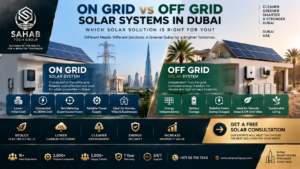
What Is an On-Grid Solar System?
To begin with, an on-grid solar system — sometimes called a grid-tied system — remains connected to the public electricity grid at all times. Solar panels generate electricity during daylight hours, and the property uses this power directly. Excess electricity is typically exported back to the grid, while additional power is drawn from the grid whenever solar generation falls short, such as at night.
In Dubai, on-grid systems generally operate under the Shams Dubai initiative, which allows eligible properties to connect their solar system to DEWA’s network and receive credit for excess energy exported, effectively offsetting future electricity bills.
Since these systems rely on the grid as a backup rather than storing energy themselves, they typically don’t include a battery — one of the biggest cost and functionality differences compared to off-grid setups.
What Is an Off-Grid Solar System?
By contrast, an off-grid solar system operates completely independently of the public electricity network. Instead of exporting excess power to the grid, it stores surplus energy in batteries, and the property draws on that stored power whenever solar generation isn’t available — such as at night or during cloudy periods.
Without a grid connection to fall back on, the system must be carefully sized to handle a property’s full energy needs, including a buffer for periods of lower sunlight. As a result, off-grid setups typically need a larger battery bank and a more robust design than on-grid systems.
Property owners most commonly choose off-grid systems for remote locations without access to DEWA infrastructure, though some select them intentionally for full energy independence, regardless of location. Evaluating on grid vs off grid solar setups helps you choose the most reliable energy solution.
What Is a Hybrid Solar System?
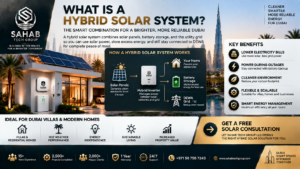
Worth mentioning alongside the two main categories, a hybrid solar system combines elements of both. It stays connected to the grid, like an on-grid system, while also including battery storage, like an off-grid system.
This means a hybrid setup can:
- Use solar power directly during the day
- Store excess energy in batteries for later use
- Draw from the grid when both solar and battery power are insufficient
- Continue supplying essential power during grid outages, depending on system design
Because hybrid systems offer both grid connectivity and backup power, more Dubai property owners are choosing them as a middle-ground option that adds energy resilience without going fully off-grid.
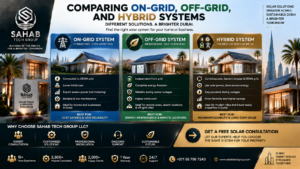
Comparing On-Grid, Off-Grid, and Hybrid Systems
| Factor | On-Grid | Off-Grid | Hybrid |
|---|---|---|---|
| Grid connection | Yes | No | Yes |
| Battery storage | Not required | Required | Included |
| Works during power outage | No (unless paired with battery) | Yes | Yes, depending on design |
| Relative system cost | Lower | Higher | Higher |
| Best suited for | Grid-connected properties wanting bill savings | Remote/off-grid locations | Properties wanting backup power + grid savings |
| Maintenance complexity | Lower | Higher (battery upkeep) | Moderate to higher |
| Export credit eligibility | Yes, via Shams Dubai | No | Often yes, depending on setup |
Each system serves a different purpose, so the “better” option genuinely depends on the property’s location, energy goals, and budget — rather than one being universally superior to the others.
Key Differences That Actually Matter for Homeowners
Energy Independence vs Grid Reliance
Fundamentally, on-grid systems still depend on DEWA for power at night, whereas off-grid and hybrid systems reduce or eliminate that dependence, depending on battery capacity.
Performance During Power Outages
On-grid systems without batteries shut down automatically during a grid outage for safety reasons, so they generally won’t power the property when DEWA supply is interrupted. Off-grid and hybrid systems, by comparison, can keep running on stored battery energy.
Battery Costs and Maintenance
Batteries represent a significant portion of system cost and require periodic monitoring or replacement over time. Consequently, off-grid and hybrid systems generally cost more upfront and involve slightly more ongoing maintenance than on-grid setups.
Bill Offsetting Through Export Credits
Through Shams Dubai, on-grid and many hybrid systems allow excess solar energy to flow back to DEWA in exchange for bill credits, meaningfully offsetting electricity costs over time. Fully off-grid systems miss out on this benefit, since they aren’t connected to the grid at all.
Which System Is Right for Your Property?
Choose On-Grid If:
- Your property already has a DEWA connection
- Your main goal is reducing electricity bills
- You don’t need backup power during outages
- You want a simpler, lower-cost setup
Choose Off-Grid If:
- Your property has no access to grid infrastructure
- You want complete energy independence
- You’re willing to invest in battery storage and upkeep
- Reliability during outages is a top priority
Choose Hybrid If:
- You want both bill savings and backup power
- Your area experiences occasional power outages
- You’re open to a higher upfront investment for added resilience
- You want flexibility to expand battery storage over time
What Affects the Cost of a Solar System in Dubai?
Solar system costs vary considerably depending on several interconnected factors.
- System type — on-grid, off-grid, or hybrid
- System size — measured in kilowatts (kW), based on energy needs
- Battery capacity — for off-grid and hybrid systems specifically
- Panel quality and brand
- Inverter type and capacity
- Roof condition and installation complexity
- Property size and energy consumption patterns
Because these variables interact, two properties with similar roof space can end up with meaningfully different quotations depending on system type and battery requirements.
Estimated Solar System Costs in Dubai (2026)
| System Type | Estimated Cost in Dubai (AED) |
|---|---|
| On-grid system (5kW villa) | 15,000 – 25,000 |
| On-grid system (10kW villa) | 28,000 – 45,000 |
| Hybrid system (5kW + battery) | 35,000 – 60,000+ |
| Hybrid system (10kW + battery) | 65,000 – 110,000+ |
| Off-grid system (small property) | 40,000 – 80,000+ |
| Off-grid system (larger property) | 90,000 – 200,000+ |
| Battery storage (per kWh, add-on) | 1,500 – 3,500 |
*These are indicative estimates only. Actual pricing depends on system size, battery capacity, brand selection, and site-specific conditions. A professional site assessment remains the most reliable way to obtain an accurate quotation.
Payback Period: On-Grid vs Off-Grid vs Hybrid
| System Type | Typical Payback Period |
|---|---|
| On-Grid | Shorter — generally the fastest to recover investment |
| Hybrid | Moderate — longer due to battery cost, offset by outage resilience |
| Off-Grid | Longest — highest upfront cost, though justified where no grid access exists |
Generally speaking, on-grid systems tend to offer the fastest return on investment for grid-connected properties, since lower upfront costs combine directly with Shams Dubai export credits. Off-grid systems, meanwhile, are less about payback period and more about necessity or energy independence. Evaluating on grid vs off grid solar setups helps you choose the most reliable energy solution.
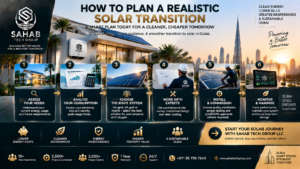
How to Plan a Realistic Solar Transition
Regardless of which system type fits best, a structured approach tends to produce better long-term results than jumping straight to a quotation.
Start With an Energy Audit
Reviewing 6–12 months of DEWA bills gives a clearer picture of actual consumption than estimating from memory, helping installers size the system accurately.
Assess Roof Condition Early
Panel installation depends heavily on roof space, orientation, and structural condition, so an early site assessment can flag issues like shading before they affect system design.
Factor In Future Energy Needs
Accounting for planned additions — an EV charger, a pool pump, or expanded AC capacity — before finalizing system size helps avoid an undersized setup within just a few years.
Common Mistakes When Choosing a Solar System Type
Choosing Off-Grid When On-Grid Would Suffice
Occasionally, property owners assume off-grid automatically means “better,” when a grid-connected property with reliable DEWA access rarely needs the added cost of full energy independence.
Underestimating Battery Requirements
Undersizing battery capacity for an off-grid or hybrid system can cause power shortages during extended low-sunlight periods, defeating the purpose of the investment.
Overlooking Shams Dubai Eligibility
Some property owners install an off-grid system without checking whether an on-grid or hybrid setup eligible for export credits would serve them better.
Not Planning for Future Energy Needs
Sizing a system based only on current consumption, without accounting for future additions like an EV charger, can leave the system undersized within just a few years. Evaluating on grid vs off grid solar setups helps you choose the most reliable energy solution.
A Practical Checklist Before Choosing a Solar System
- □ Confirm whether your property has DEWA grid access
- □ Define your primary goal (bill savings, backup power, or independence)
- □ Estimate current and future energy consumption
- □ Decide whether battery storage is a priority
- □ Check Shams Dubai eligibility for export credits
- □ Compare on-grid, off-grid, and hybrid quotations
- □ Confirm roof suitability and installation requirements
- □ Request a detailed, itemized quotation before proceeding
How Sahab Tech Group LLC Can Help
Given how many factors go into choosing the right setup, Sahab Tech Group LLC provides solar system design and installation services across Dubai, covering on-grid, off-grid, and hybrid solutions for residential and commercial properties.
With 15+ years of industry experience, the team supports property owners with:
- Solar system assessment and sizing
- On-grid installation with Shams Dubai coordination
- Hybrid systems with battery backup
- Off-grid solutions for remote properties
- System maintenance and performance monitoring
- Guidance on choosing the right system type for your needs
Why Choose Sahab Tech Group LLC for Solar Installation?
| What You Need | Sahab Tech Group LLC |
|---|---|
| Experienced solar installation team | 15+ years of industry experience |
| On-grid, off-grid & hybrid expertise | ✓ |
| Shams Dubai coordination support | ✓ |
| Battery storage solutions | ✓ |
| Transparent, itemized quotations | ✓ |
| Dubai-wide service | ✓ |
Conclusion
Choosing between an on-grid, off-grid, or hybrid solar system ultimately comes down to a property’s grid access, energy goals, and budget, rather than one system being universally better than the others. On-grid systems generally suit grid-connected properties focused on reducing electricity bills, off-grid systems serve locations without grid access or owners prioritizing full independence, and hybrid systems offer a balanced middle ground for those wanting both savings and backup resilience.
Understanding how each system works, along with realistic cost expectations, puts property owners in a stronger position to choose an option that aligns with both their energy needs and their long-term budget.
If you’re considering solar for your property and want expert guidance on which system type genuinely fits your situation, professional support can make the process considerably clearer. Evaluating on grid vs off grid solar setups helps you choose the most reliable energy solution.
Contact Sahab Tech Group LLC at +971 56 756 7243 to discuss your solar project or request a professional quotation.
FAQs
1. What’s the main difference between on-grid and off-grid solar systems?
Essentially, on-grid systems stay connected to the DEWA network and rely on it for power when solar generation isn’t sufficient, while off-grid systems operate independently using battery storage instead.
2. Does an on-grid solar system work during a power outage?
Generally, no — unless paired with a battery, on-grid systems shut down during outages for safety reasons, since they rely on the grid connection to operate.
3. Which system offers the fastest return on investment?
Typically, on-grid systems offer the fastest payback period, mainly due to lower upfront costs and eligibility for Shams Dubai export credits on excess energy.
4. Is a hybrid solar system worth the extra cost?
For many property owners, yes — particularly if backup power during outages is a priority alongside ongoing bill savings, since hybrid systems offer both benefits in one setup.
5. Can I switch from an on-grid to a hybrid system later?
In many cases, yes, since some on-grid installations can be upgraded with battery storage later on. That said, this depends on the original system design, so it’s worth confirming compatibility upfront.